Ordinary rate delivery form: AW-DO-10 (47).
- Australia 1901-1988
- New South Wales
- Overview of NSW
- Telegraph lines
- Telegraph Offices
- Date stamps
- Forms
- Envelopes
- Instructional annotation
- Collect
- Delayed
- Free
- Immediate Urgent
- Reply paid
- Rates
- Rates
- Summary of Telegram rates 1858-1900.
- NSW - Qld rates 1858 to 1870
- NSW - Vic rates 1858 to 1870
- Stamps
- 1871 Telegraph stamps
- 1885 proposal
- 1893 proposal
| Heading and notes: | 1947 printing. Form number T.G. 42. Standard heading above TELEGRAM. |
| Message area: | Blank - area occupies nearly 80% of form. |
| Reverse side: | Blank. |
| Colours (text & form): | Blue on cream. |
| Size of form overall: | 101 × 195 mm. |
- printed with Form numbers T.G. 42, T.G. 42B or T.G. 42 BB.;
- the main distinctions amongst the varieties are:
10A: standard format - "/" between the month and the year for the date and five lines of text in the top left box with no hyphenated words;
10B: has form number T.G. 42B and "No." beneath the line aligned with T/C/B above;
10BB: has form number T.G. 42BB and was printed in July;
10C: has form number T.G. 42; six lines of text in the top left box with two words hyphenated; printed in August 1947;
10D: no form number.
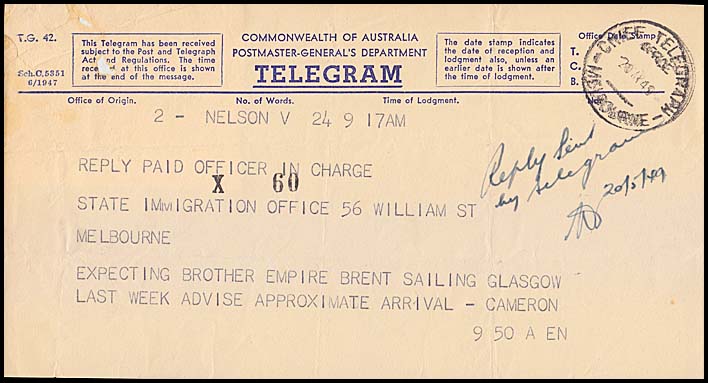 Printed in June 1947. Printed in June 1947. |
AW-DO-10A (47).
Nelson to CTO Melbourne, Vic. (20 May 1949). Characteristics: Standard format;
|
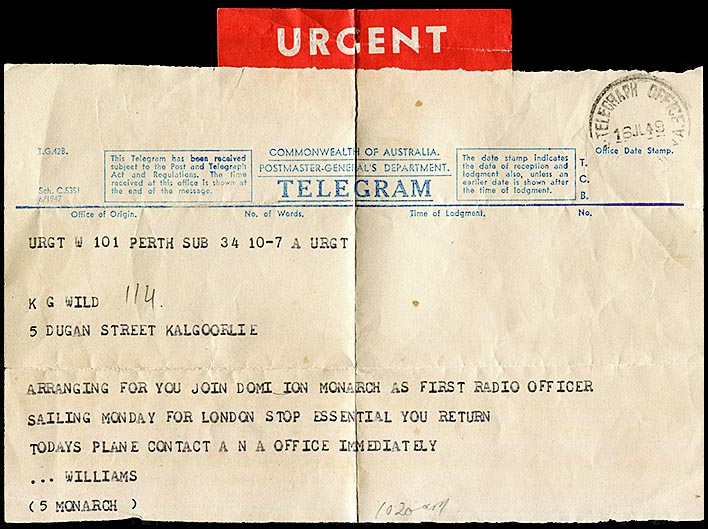 Printed in June 1947. Mr. Wild was joining the Dominion Monarch five months after she had carried the New Zealand Cricket team to England for its summer tour and two months before she carried the New Zealand All Blacks Rugby Union team back home from Durban after their South African tour. |
AW-DO-10A (47).
Possibly a cable from London via Perth to Kalgoorlie. A significant telegram for its contents. It was requiring Mr. Gerald Wild (later based in Exmouth W.A.) to immediately join the S.S. Dominion Monarch as First Radio Officer. This ship was one of the largest and most significant cruise ships in the world. She served the England - Australia - New Zealand route for two years before serving as a troop ship during the war and then returningn to civilian cruises. She could carry 535 passengers and a crew of 385. |
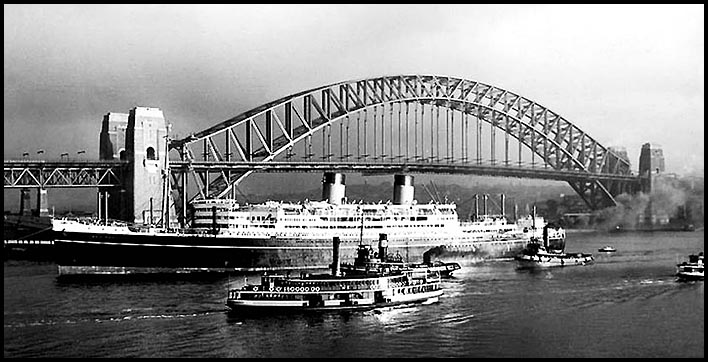 The Dominion Monarch in Sydney Harbour during one of its voyages. |
|
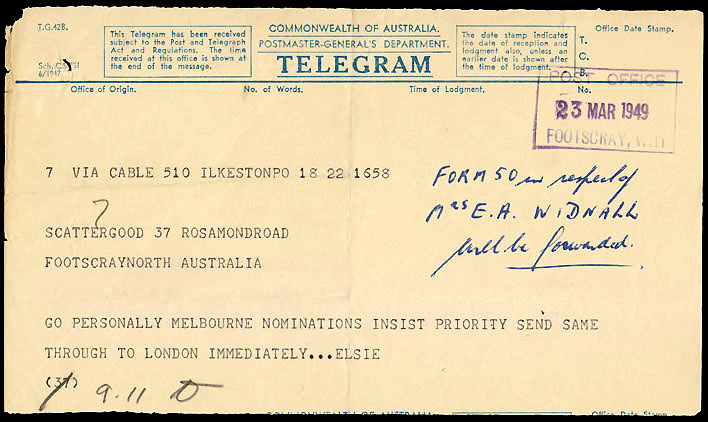 Printed in June 1947. |
AW-DO-10B.
Ilkeston P.O. UK by Cable to Footscray (23 March 1949). Characterstics:
|
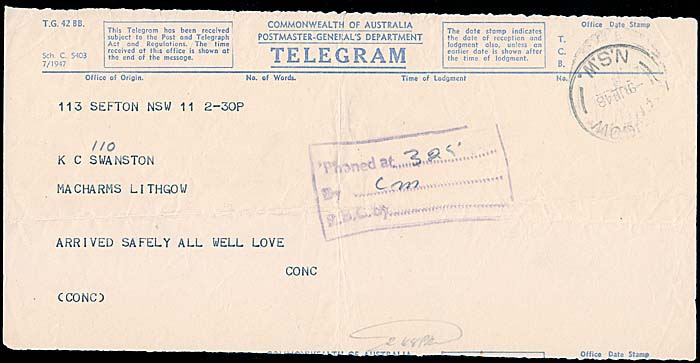 Printed in July 1947. |
AW-DO-10BB (47).
Sefton to Lithgow Characteristics:
|
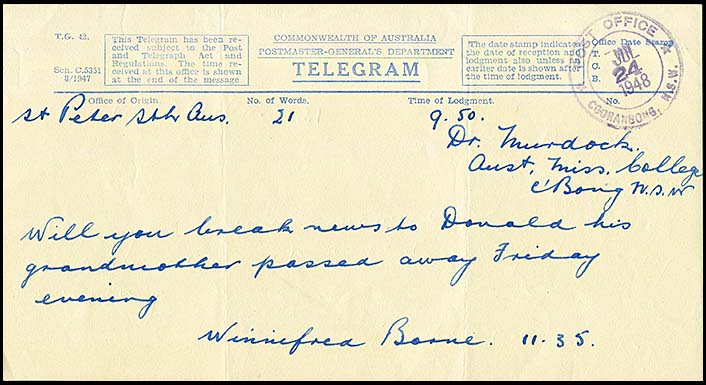 Printed in August 1947. |
AW-DO-10C (47).
St Peter, SA to Cooranbong, NSW Has rubber POST OFFICE date stamp. Characteristics:
|
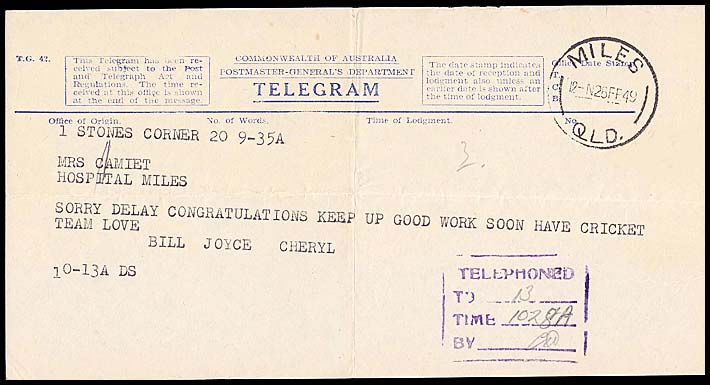 Printed in June 1947. |
AW-DO-10D (47).
Stones Corner, Qld to Miles, Qld (25 February 1949). Characteristics:
Few of these forms have been seen and they are all used in Queensland. |
Details of use and rarity.
| Form sub-number |
Schedule number | Earliest recorded date | Rarity rating |
| DO-10Aa (47) | Sch. C. 5351 6/1947. | 14 January 1949 at Geelong West. | C |
| DO-10B (47) | Sch. C. 5351 6/1947. | 23 March 1949 at Footscray, Victoria. | C |
| DO-10BB (47) | Sch. C. 5403 7/1947. | 9 June 1948 at Lithgow, NSW. | C |
| DO-10C (47) | Sch. C. 5351 8/1947. | 24 July 1948 at Cooranbong, NSW. | C |
| DO-10D (47) | None. | 25 February 1949 at Miles, Qld. | R |
| TG42 home page | TG 42 type 9 (1940-42) |
1943 | 1944 | 1945 | 1946 | 1947 | 1948 | 1949 | ||
| 1950 | 1951 | 1952 | 1953 | 1954 | 1955 | 1956 | 1957 | 1958 | 1959 | 1960 |