Telegram delivery notifications and actions.
- Australia 1901-1988
- New South Wales
- Overview of NSW
- Telegraph lines
- Telegraph Offices
- Date stamps
- Forms
- Envelopes
- Instructional annotation
- Collect
- Delayed
- Free
- Immediate Urgent
- Reply paid
- Rates
- Stamps
- 1871 Telegraph stamps
- 1885 proposal
- 1893 proposal
Forms and dockets were used to track delivery of telegrams for a number of purposes:
- to inform a recipient that an attempt had been made to deliver a telegram.
- to account to the sender that a telegram had been delivered;
- to account to the sender that a telegram had NOT been delivered;
- unique form addressing the cost of delivery beyond usual boundaries.
The Regulations describing the purpose and use of these dockets are provided elsewhere.
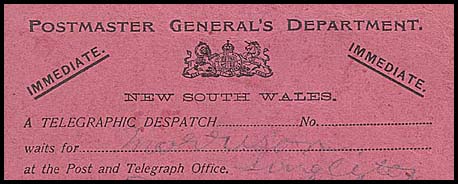
1. Dockets informing a recipient of an awaiting telegram.
| A system to inform the recipient of a telegram that a message was awaiting that person at their house or office or at the Telegraph Office had been used since the 1870s in New South Wales (see NC-AD-1).
Although other Colonies would have used a similar system, no examples of those dockets are recorded. |
 |
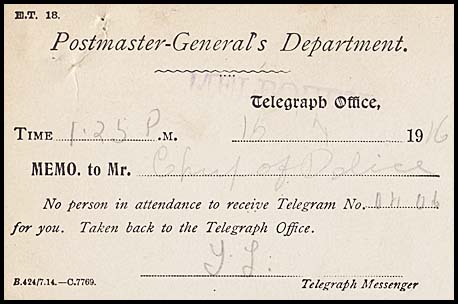
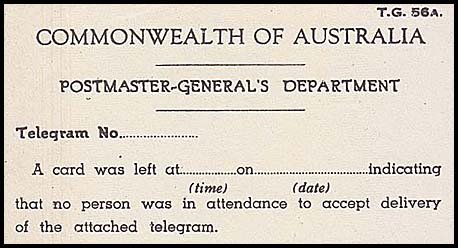
The first Commonwealth advice dockets for recipients of telegrams were issued during the Interim period. These were small cards which were generally left in the letter-box. The heading was POSTMASTER-GENERAL'S DEPARTMENT with no State reference and this heading was maintained until 1955. The Form number was E.T. 18 which carried over from most Colonial administrations by referencing the Electric Telegraph. This number was changed at some time to T.G. 56. |
 |
The system of using small cards to advise recipients that a messenger had called to deliver a telegram but was unable to contact the addressee was continued during the Commonwealth era. The dockets issued during the PMG period - up until 1955 - can be accessed using the hyperlink.
|
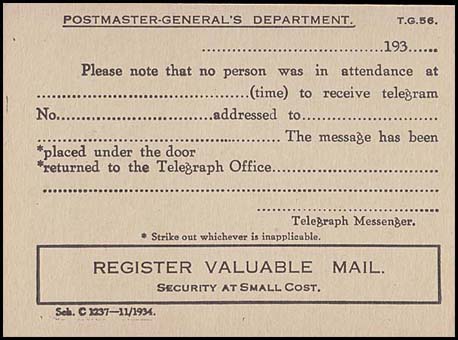 |
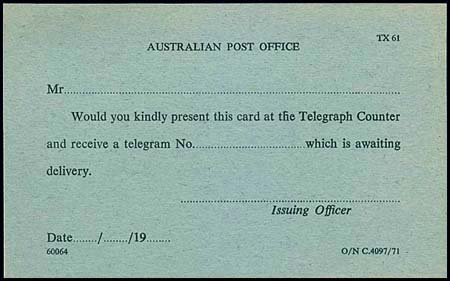
Some time after 1955, the post-PMG period saw the heading changed again to with the form number changing to |
 |
| Frequently these dockets were accompanied by small stickers which were then affixed to the telegram delivery envelope as a record that the messenger had been unsuccessful in contacting the recipient.
When that system did not work or had ended, messengers would simply annotate the envelope with a comments such as CARD LEFT. Alternatively, hand stamps would summarise a situation. Telecom did however continue to use cards in some areas (AT-AD-11 and 12). |
 |
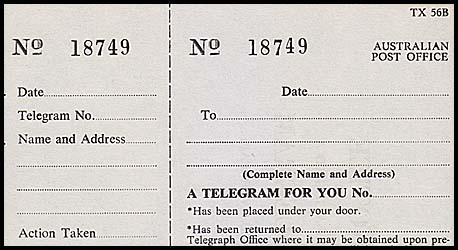
The small cards were later replaced by paper dockets torn from a book which also contained a stub to facilitate tracking of actions taken.
|
 |
| The final stage - introduced progressively - developed when telephones became widespread. Messages were then telephoned to the recipient and the paper record was posted through the normal mail. Delivery envelopes were handstamped with a relevant note saying the article had been posted. That procedure soon signalled the end of the employment of Telegraph Messengers. | |
2. Dockets to inform the sender of a telegram of its delivery.
| At some time, a form (66a) was introduced (AB-AD-1) to inform the sender of a telegram that the message had been delivered or called for at the local Telegraph Office. No early forms are known although they are believed to exist. The earliest recorded printing date is August 1955. This form was again discontinued in 1983. | 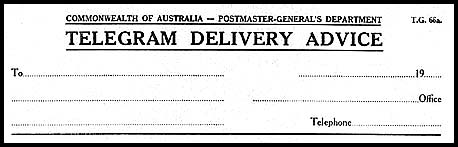 |
ABOLITION OF TELEGRAPH MESSENGERS' TICKET BOOKS
It has been decided that, as it is not now necessary to obtain receipts for telegraphic messages (other than Cablegrams) on delivery to the addressees, the use of Telegraph Messengers' Ticket Books shall be discontinued after the present supply is exhausted and, in place thereof, dockets will be used. A supply of such dockets equal to the probable demand will be furnished to the principal offices throughout the State, while at small offices, where few, if any cablegrams are received for delivery, a receipt for the message can be obtained in the following form, which resembles the proposed docket.
Then followed an example of a Cablegram receipt docket.
In 1909, the Regulations were amended as follows:
No receipts from the addressees need be taken upon the delivery of telegrams originating and delivered within the Commonwealth. Should it be necessary to obtain evidence of the delivery of a telegram, a receipt therefor, by telegram, may be ordered at the time such telegram is lodged for transmission and shall be telegraphed back to the sender upon payment of ordinary telegraph charges, or if desired sent by post-card on payment of 1d.
This Regulation was repeated as Paragraph 351 in the June 1922 Post and Telegraph Guide with "1d" replaced by "the necessary postage".
3. Dockets informing the sender of a telegram of its non-delivery.
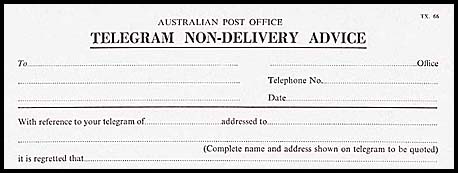
| By 1929, Form 66 had been designed essentially to cover the cases where a telegram could not be delivered (see Hancock, p. 173).
The early version of the form had no heading. By 1940, a heading TELEGRAM NON-DELIVERY ADVICE had been added to Form 66 (see AB-AD-2). |
 |
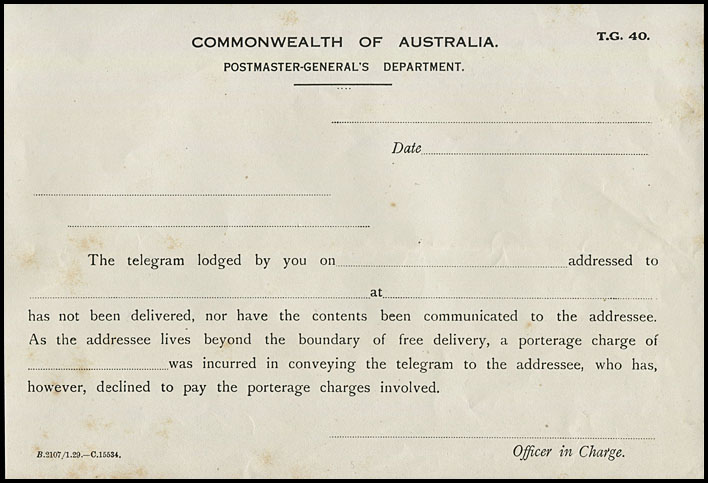
4. Forms for charging porterage costs.
Only one form explicitly addressing porterage costs is now known.
 |