- Australia 1901-1988
- New South Wales
- Overview of NSW
- Telegraph lines
- Telegraph Offices
- Date stamps
- Forms
- Envelopes
- Instructional annotation
- Collect
- Delayed
- Free
- Immediate Urgent
- Reply paid
- Rates
- Stamps
- 1871 Telegraph stamps
- 1885 proposal
- 1893 proposal
Details reviewed on this page are:
- Overview of the General Post Office;
- Overview of the Electric (later Chief) Telegraph Office;
the two temporary George Street Offices;
accommodation at the new GPO;
changes in name and implications for date stamps;
stories about life in the Electric Telegraph Office (especially Chess);
- the Colonial date stamps of:
the Sydney date stamp;
the Electric Telegraph Department;
the Electric Telegraph Office;
the Post & Tel. Dept.;
- the Interim/Australian date stamps of:
the Telegraph Branch;
C.E.T.O;
Chief Telegraph Office (in steel);
C.T.O;
Chief Telegraph Office (rubber);
C.T.O. (rubber);
- Electric Telegraph Stationery.
- See also the following Slogan Cancellations used at Sydney:
* Send a Telegram;
* Send Greetings by Telegram;
* Send Birthday Greetings by Telegraph ...;
* Convey Congratulations by Telegraph ...;
* 100 Years Celebration ...;
* A Telegraphic Code Address ...;
* Other slogans used at Sydney.
|
The first Post Office, operated by the first Post Master Isaac Nichols, was located in a variety of premises over the years. With the acceptance of responsibility by the N.S.W. Government in 1857 to provide telegraphic communication - especially to Victoria - it became recognised that a different building was required for the Telegraph Office. At that time, the proposed telegraph operation - with the lines and offices - was not part of the Postal Department but part of Public Works. Indeed, after separation from Public Works, it became an independent Department in its own right. |
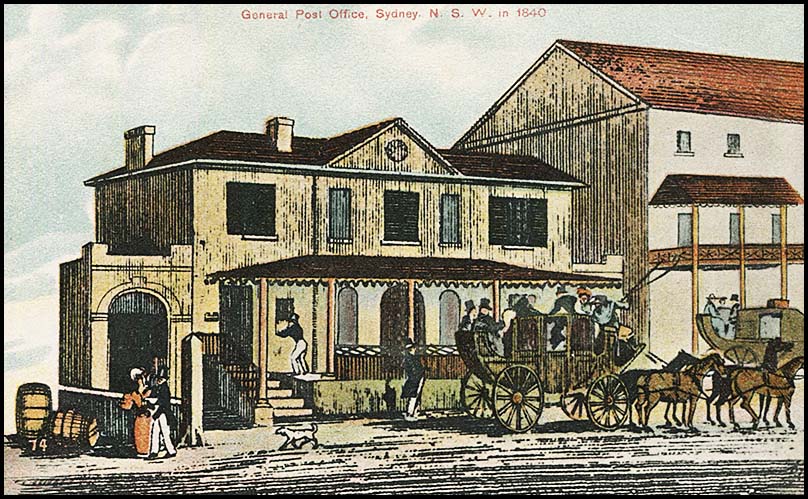
The first three locations for the Electric Telegraph Department.
Location 1: Sydney Exchange.
The first Electric Telegraph Office was situated in the Sydney Exchange building on the corner of Bridge Street and Pitt Street. It commenced operations on 30 December 1857 as part of the first lines of Telegraph in the Colony - extending to South Head, to Liverpool via Redfern and to Fort Phillip.
Responsibility for the Electric Telegraph Department was at that time held by the Department of Public Works. It was administratively within the Department of Internal Communication.
The importance of the telegraph as a means of communication was immediately realised. The Sydney Morning Herald of 11 July 1859, for example, reported:
"The pressure of business at the Sydney Telegraph Office, after the arrival of the Salsette in South Australia, was very great. The office opened at half-past eight o'clock on Tuesday morning, as usual, and messages were received and transmitted without intermission until half-past six o'clock on the following morning, when an interval of two hours occurred before the ordinary work of the day again commenced. During the above period, 104 messages were received and 66 were transmitted - the total number of words being 11,880 and the total value of the messages, £169 6s. 8d. The total number of messages passed over the line during the day was 206. Yesterday there was a sudden break in the line, just as a message was passing through. A second wire from Sydney to Adelaide via Deniliquin is greatly needed, not only to lighten the work on the present line in time of great pressure, but to guard against total stoppages, which generally happen, at the most inconvenient times".
As described elsewhere, it was considered prudent by both parties that the Telegraph Department should move to different premises at the end of the four year lease.
Location 2: The 394 George Street Telegraph Office.
As demand for telegraphic services grew, the Department was moved from the Exchange in 1860 to a building on the south side of the General Post Office in George Street. The Empire of 6 October 1860 reported "Mr. J. B Laverack submitted the materials of the old Watch House, situate in George Street, to public competition last Saturday, Mr. Eather becoming the purchaser for the sum of £53. Workmen are now busily engaged removing it and doubtless the new telegraph office will shortly be proceeded with. Mr. James Atkinson, sen., has the contract for its erection".
The Sydney Morning Herald of 21 November 1860 carried the following advertisement:
NOTICE is hereby given that, on and after WEDNESDAY MORNING next, the 21st Instant, the New Electric Telegraph Office, in George Street, will be OPENED and MESSAGES will in future be transmitted and issued therefrom, instead of from the Exchange.
By order,
(Signed) B. H. MARTINDALE, Superintendent.
The Treasury, New South Wales.
14th November, 1860.
Soon after the Herald reported: "The gentlemen of the Electric Telegraph Department have, given a complimentary dinner to Mr. Cracknell, the Superintendent, on the occasion of their removal to the new centrally located station."
Original photograph kindly supplied by Don Adams. |
|
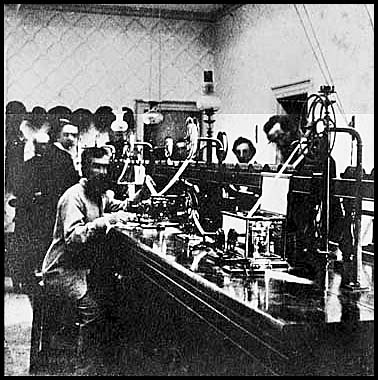 The Operating Room of the Electric Telegraph Office in George Street in 1860. There was a staff of six. |
The address of 390 George Street is now on the north-east corner of the intersection of George Street and King Street. The Post Office building was north of that corner. |
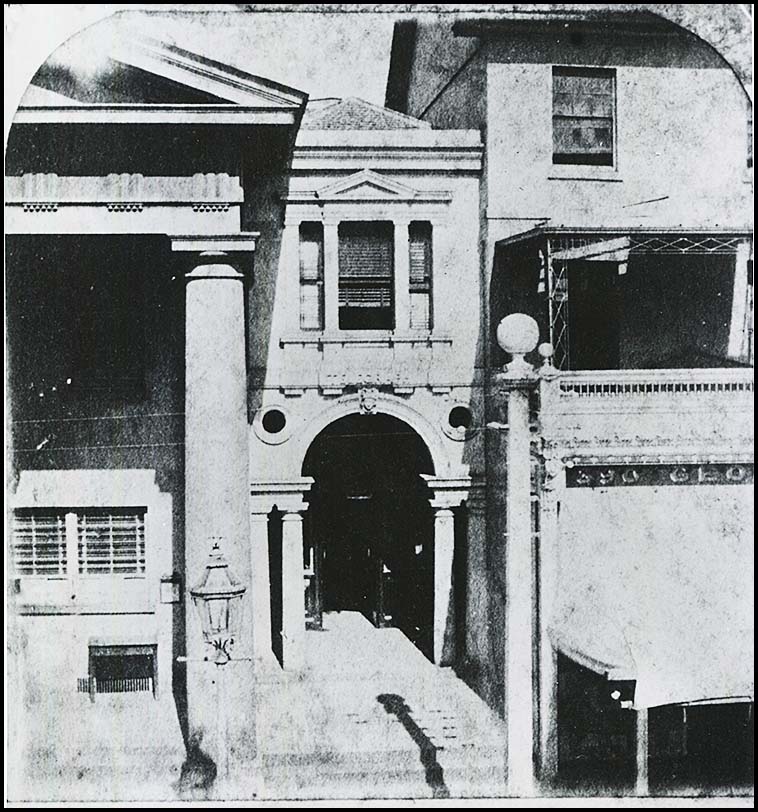
Beginning of the construction of the 1874 Post and Telegraph Office.
In his Report for the Year 1860, Mr. Cracknell acknowledged the need to construct new premises for all parts of the service and also to construct a purpose-designed building:
"during the last year (when) the Telegraph Office has been joined to the Sydney Post Office; and the latter establishment has been still further curtailed, having lost the lobby where I proposed the Money Order Office should be, as well as two store-rooms, the letter carriers' lobby, and part of the room used for the sale of stamps. Under present circumstances, therefore, I am disposed to recommend, in cases the money order system should now be introduced, that its operations should commence in some detached building, and be under the control of a superior officer of the latter branch, under whom the two clerks should be places. As the accounts connected with money orders are quite distinct from the usual postal routine, 1 apprehend that some such plan would not interfere with the efficiency of the financial details, although it would to some extent increase the cost of the establishment".
On 27 September 1861, the Colonial Treasurer (Mr. Weekes) said in the House: "the Government thought it desirable that the Office of Electric Telegraph and Post Office should be conducted in the same building and they intend to carry out this arrangement when circumstances enable them to do so".
Strategies for the construction of a new Post Office - to incorporate the Electric Telegraph Office - commenced in 1862. In that year, a new Post and Telegraph Office building was designed by the then Colonial Architect James Johnstone Barnet. He wanted a proper building to reflect its importance in the Colony and so designed a 100 yard structure on the site of the old building running between George Street and Pitt Street and fronting St. Martins Lane (now Martin Place).
The first barrier was that the Government did not own enough of the site. The Sydney Morning Herald in August 1864 informed its readers as to how this problem was solved:
"The New General Post Office.
We are informed that the Government, after protracted negotiations, yesterday effected, through Messrs Mort and Co., the purchase from Mrs. John Therry-Hughes of a frontage in Pitt Street, abutting on the eastern end of the site of the old Post Office and continuing its northern boundary from George Street to Pitt Street. This purchase, it is stated, has been made for the purpose of permitting the extension of the proposed new Post Office beyond the limits of the land forming the site of the old building. It is with a view to effect the opening up of a new street in continuation of Barrack Street through to Pitt Street, for which object Mrs. Hughes has agreed to give up on her part, in conjunction with the Government, a sufficient extent of land to carry out a most desirable public convenience. The block of buildings bounded by Hunter, George, King and Pitt Streets, is the longest undivided block in the city, having only as a means of cross passage the permissive use of the entry through Mort's buildings.
By the purchase referred to, the Government, we believe, have secured a street frontage of 320 feet available for the erection of the new General Post Office for which the Assembly had liberally voted £40,000. Beyond this great advantage, so far as the Post Office is concerned, there will now be sufficient land in possession of the Government to admit of the Money Order and Telegraph Offices being included in the same building with the Post Office.
It is probable that competitive designs will be called for, and the new building set in progress as early as possible".
Location 3: The Bate building.
At the beginning of the process of constructing the new G.P.O. from 1864, both the Post Office and the Telegraph Office had to be relocated to temporary locations:
- the Post Office moved to what is now Wynard Square see photograph below;
- the Electric Telegraph Department had to be moved further south along George Street nearer to the corner of King Street and on the western side of George Street. The move involved the closure of a major and well established Drapery.
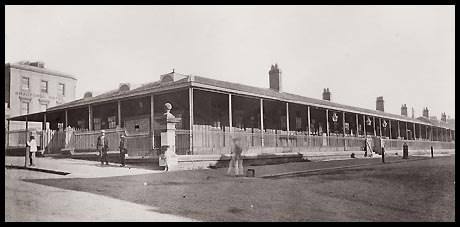 From 1865 to 1874, the G.P.O. was relocated to Wynard Square. From 1865 to 1874, the G.P.O. was relocated to Wynard Square.This temporary building for the Post Office was demolished after Stage 1 of the new G.P.O. opened. The building at the rear is now the Occidental Hotel in York Street. Taken March 1871. |
On 15 July 1865, the Sydney Morning Herald carried the following:
REMOVAL OF THE OLD POST OFFICE.
|
Advertisements announcing the closing sale of Mr. Bate's Drapery appeared in a number of newspapers - that in the Sydney Empire of 23 June 1865 was as follows:
IMPORTANT NOTICE. REMOVAL OF THE ELECTRIC TELEGRAPH OFFICES. CHARLES BATE and CO. beg to announce to their numerous friends and the public generally that, having disposed of their extensive and centrally situated premises, known as BRITANNIA HOUSE, to the GOVERNMENT for the ELECTRIC TELEGRAPH OFFICES, the whole of their VALUABLE STOCK of General DRAPERY. SILKS, SHAWLS, MANTLES, MILLINERY, UNDERCLOTHING, MEN'S MERCERY, &., must be IMMEDIATELY CLEARED to effect which IMMENSE REDUCTIONS HAVE BEEN MADE IN EVERY DEPARTMENT. The STOCK has been RE-MARKED at EXTRAORDINARY LOW PRICE for this IMPERATIVE SALE. The Sale will commence each DAY, at 9 a.m. CHARLES BATE and CO., Wholesale and Retail Drapers, |
The room in Britannia House used for receiving telegrams from the public was on the ground floor. It was presided over by Mr. J. R. Miles, a sturdy gentleman, the possessor of a long flowing brown beard and a resonant voice - apparently a kindly official.
Behind this room was the messengers' den where youth held high revelry when not busy - when Mr. Miles was using his eye in another direction.
Behind, again, encroaching on to York Street, the boys stabled their "pretty ponies".
Upstairs were the administrative offices, of four or five rooms and the operating room. This latter was small, perhaps 30 ft x 15 ft, with a large table down the centre on which, connected back to back, were six telegraph instruments, all that the head office possessed or required.
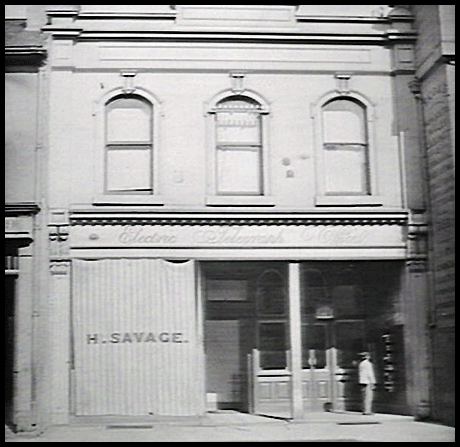 Britannia House the temporary Electric Telegraph Office 1864-1874. |
About two years after the move, the Sydney Mail of 10 February 1866 reported the following:
|
Construction completed.
A detailed description of the new Post and Telegraph Office is given in the Illustrated Sydney News of 28 November 1868. Well worth reading.
During the construction - in July 1868 - "A splendid specimen of Moruya granite was delivered, on the 8th instant, at the works in progress on the site of the George-street Post Office. The block, which weighed over six tons, is what is commonly known as grey granite, and is found in large quantities in the Southern district".
|
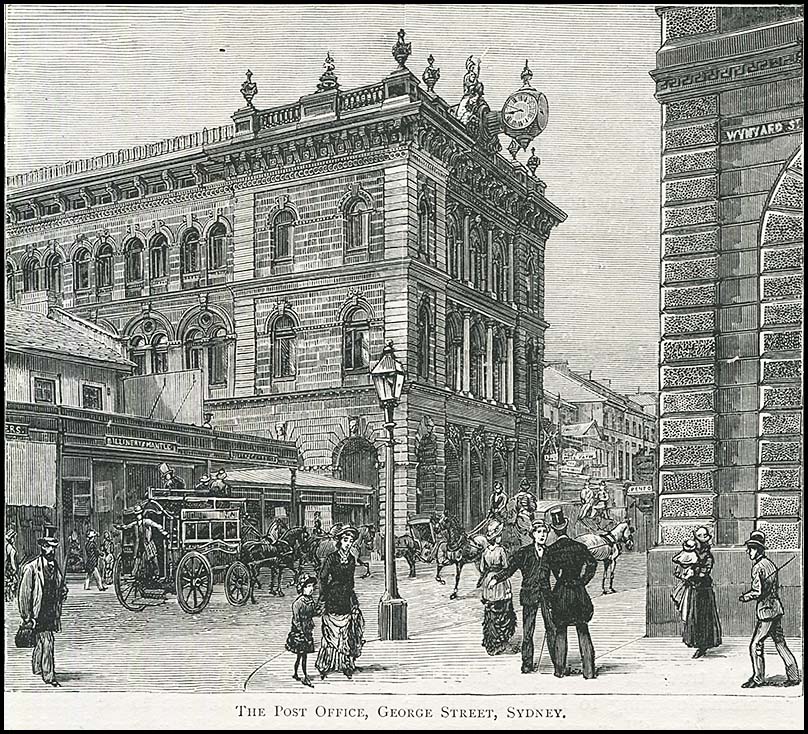
The Post Office occupied its sections in about early 1874. Later that year the Sydney Empire of July 21 1874 reported:
"A few minutes before 4 o'clock yesterday afternoon, considerable excitement was occasioned in the neighborhood of Pitt and George Streets by a loud report of an explosion. In a very few minutes, a mass of people gathered at the rear of the new Post Office from whence the report came; and as the people ran, their voices rang through the street that the clock of the new Post Office had fallen and smashed. But this was not the case. On inquiry we were informed that one of the persons in charge of the Telegraph Office had been trying an experiment upon a torpedo and, from some cause, had caused the alarm. There was no damage done, other than displacing the ends of the 'can' ".
The Electric Telegraph Department also finally moved into the new building.
In the Legislative Assembly of 21 October 1873, Ministers stated in answer to questions, that the expediency of employing female operators in the Telegraph Department was under the consideration of the Government and that a separate room would be set apart for their accommodation in the new building in the event of its being considered desirable.
The official opening took place on 1 September 1874 and it was opened for business on 28 September.
Staff of the NSW Electric Telegraph Office in the 1870s included:
|
|
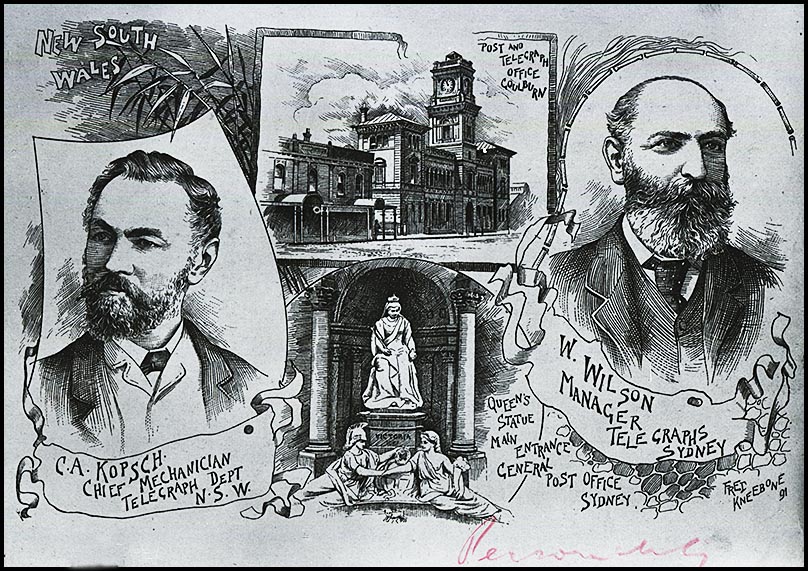
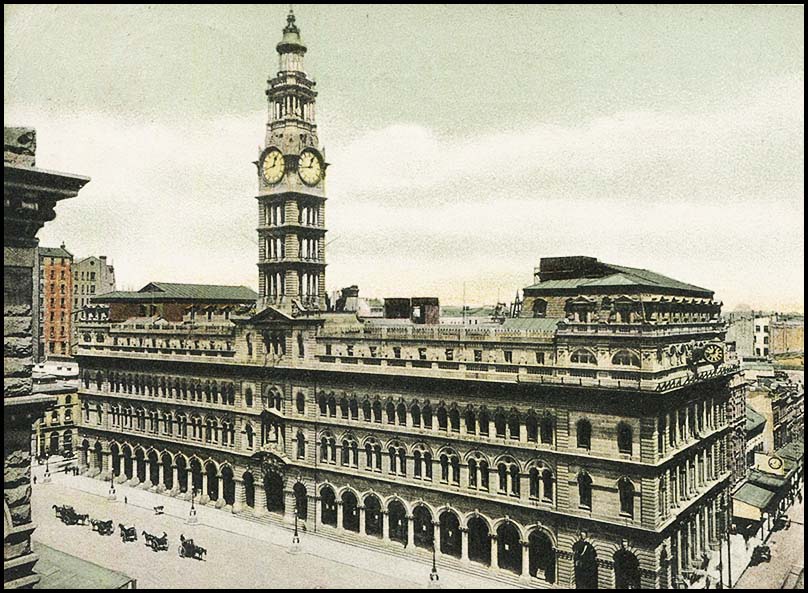
It continued to grow and acquire new spaces over the years:
- the public counter was on the George Street front;
- the operating room was on the second floor;
- the basement contained accommodation for postmen, telegraph messengers, stabling,
general storage, etc and a battery store capable of holding 1,000 cells.
|
|
|
|
|
|
|
|
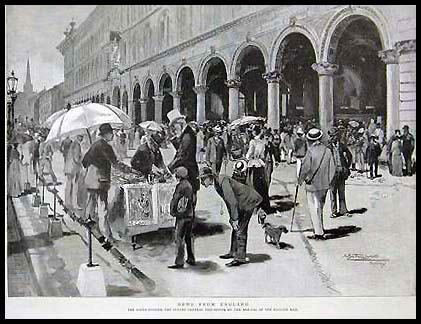
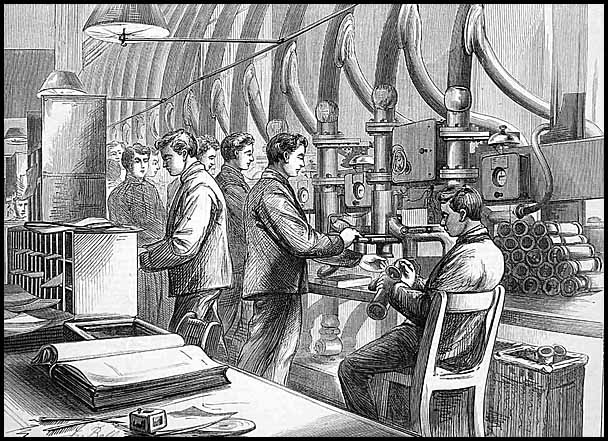
Pneumatic tubes were installed in the building in the late 1890s to carry telegrams between the receiving, operating and despatch areas.
These tubes forced small containers containing a telegram along them using compressed air. By 1910, pneumatic tubes were extended to the Merchants' Exchange building as well as to the Pacific Cable Board office. Later the system was extended further to connect all five city post offices (in 1930) as well as the Sydney Morning Herald newspaper office. |
 |
The Post and Telegraph Department.
Original photograph kindly supplied by Don Adams. |
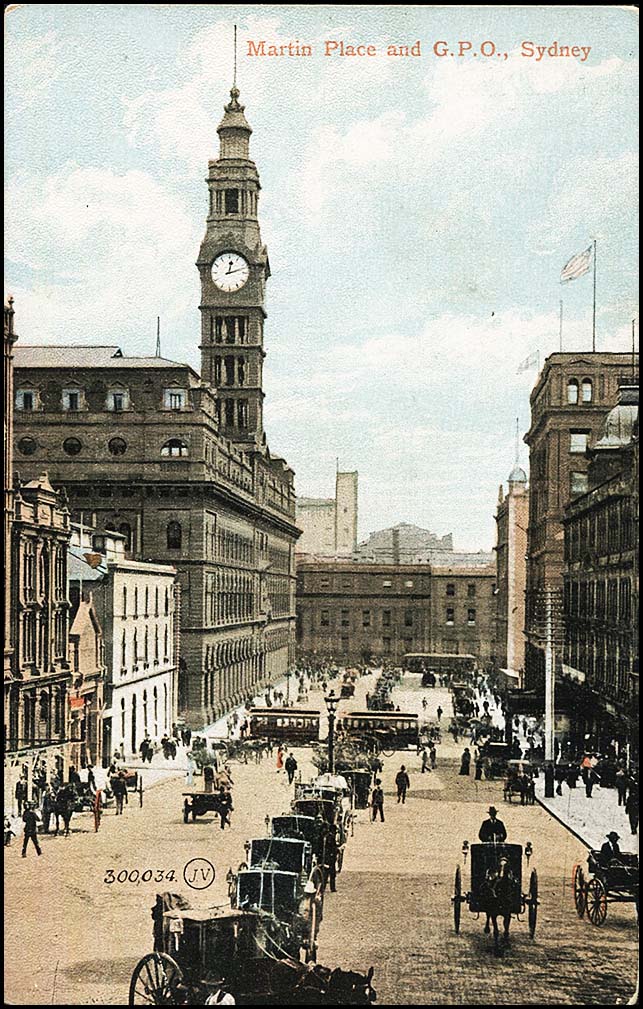
The Department merged with the Postal Department on the death of Mr. E. J. Cracknell in 1893 to become the Postal & Telegraph Department. In 1904, its name changed to the Telegraph Branch and, in 1917, it became the Chief (Electric) Telegraph Office. The reference to "Electric" was dropped in 1926. These changes are reflected in the date stamps and in the headings used on telegram forms. The building maintained its central importance in the NSW postal system. Unfortunately, like the Exchange building which was demolished in 1994, Governments see short term monetary benefit is far better than nearly 200 years of history. Hence the GPO was sold in 1996. The building now contains a Hotel, shops, cafes, restaurants and bars while the only postal presence is an Australia Post Post Shop.
|
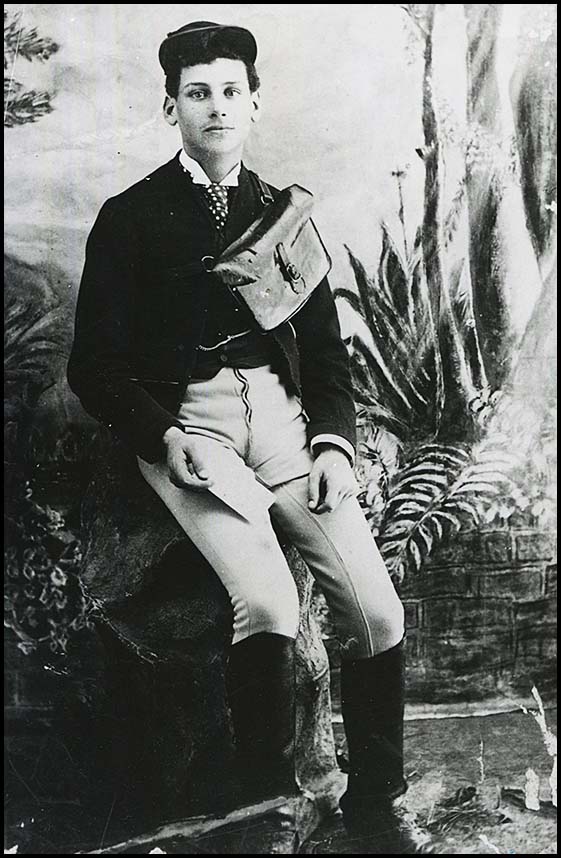
There are many stories of an unusual nature which could be collected about the Telegraph Office.
The Maitland Mercury of 7 January 1872 related to its readers the gripping details of the Intercolonial Chess Match by Electric Telegraph between representatives of the Chief Telegraph Offices in New South Wales and Queensland:
"This interesting contest was commenced on Monday (1 January). The players assembled at their Telegraph Offices shortly after 10 o'clock, but play did not commence until 11 o'clock. Unfortunately, after a few moves had been telegraphed on each side, the players were informed of the unwelcome news that the line was interrupted and play was not resumed until 2:30 pm after which it was continued until 6:00 pm. According to agreement, the players then adjourned for refreshment. They again assembled at their respective Telegraph Offices at 7:30 pm but, owing to a severe thunderstorm at Murrurundi, no further progress could be made with the match. Therefore at 9 o'clock the players dispersed. As regards the probable result of the match, nothing can yet be said ... Mr Adams and Mr Charles Mein kindly acted as the representatives for New South Wales and Mr J. Lippman performed the same office for Queensland. Mr Hunt, of the Telegraph Department rendered able assistance, and the committee are much indebted to Mr P B Walker for his kind courtesy and assistance. We understand play will be resumed on Wednesday night at 7 o'clock".
Another match was played in May 1876 between New South Wales and Victoria. It was brought to a conclusion at 3:15 am on Thursday morning with Victoria winning 5 games, NSW 1 game and 1 game was drawn.
The head office operators had demanding shifts - commencing at 8.30 in the morning with their regular time for ceasing at 6.15 p.m. If line interruptions prevented an operator from clearing all telegrams by that time, the luckless individual whose particular line was behind had to stay on duty and clear the business if at all possible before signing off. There was one night operator, working from 6.15 p.m. until 8.30 am next morning, who was generally fully occupied with Press telegrams.
See also the long conversation involving the Premier and Postmaster of NSW in Sydney and Sir Julius Vogel in Melbourne Australia's first Zoom meeting.
The Sydney Morning Herald made an important announcement for its readers on 19 January 1883: "Arrangements are in progress for lighting the General Post Office with electricity. The sorting room of the postal department and operating room of the telegraph department are to be lighted with the Edison incandescent lights".
|
|
|
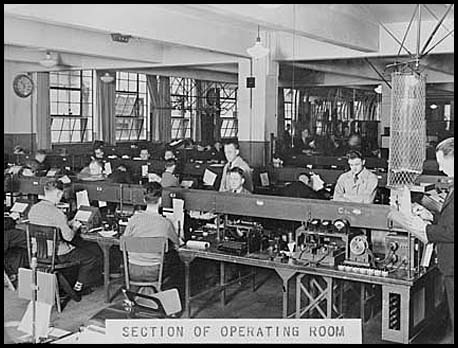
In the 1940s, this same operating room had to accommodate 400 operators and 200 telegram boys. |
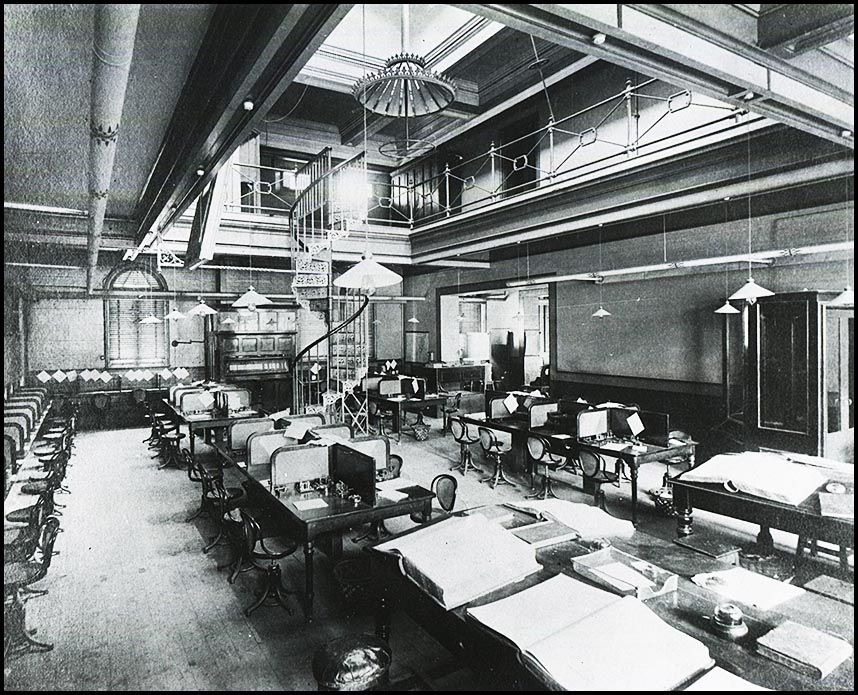
By 1890, conditions in the new Telegraph Office in the new building were becoming oppressive. The Sydney Morning Herald of 11 January 1890 reported that "plans for the fitting up of the new room for the operators employed at the Electric Telegraph Office were approved by the Postmaster-General yesterday. The operating-room at present in use will be set apart for the storage of batteries. That the change indicated will not have been made a day too soon is shown by the fact that, a few days ago, the operating room proved so exceedingly oppressive to two of the telegraphists that they were carried out of it in a fainting condition. The room is greatly crowded, there being at times no fewer than 88 operators in it The work of the department is increasing very rapidly, and it is believed that, by the end of the year, not fewer than 110 operators will be employed. The increased work will, we learn, necessitate an extension of the new operating room to adjoining premises in George Street belonging to the Post Office Department, but used temporarily by the Railway Department".
The Sydney office was extremely busy especially on important occasions. For example, on Christmas Eve of 1906, the number of telegrams handled by the Sydney Telegraph Office were:
Transmitted: 3,703;
Received: 3,411;
Repeated telegrams: 13, 695;
Cablegrams transmitted: 763;
Cablegrams received: 716;Continuing repeated telegrams as two each (they had in each instance to be received by one telegraphist and transmitted by another), the grand total was 35,983.
The date stamps for the Chief Telegraph Office.
| Sydney and regional offices.
Ordinary postal date stamp also used at Sydney on telegrams. Hancock (p. 128) lists this date stamp as the third type. The outside arc does not extend around office name. Used: 1876 to 1884. Diameter: 23 mm. |
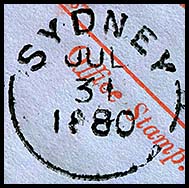 31 July 1880. Used on NC-DO-7Bb. |
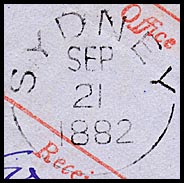 21 September 1882. Used on NC-DO-7C. |
|
Electric Telegraph Department.
| For the date stamps used at the Central Telegraphic Office with the inscription Electric Telegraph Department or some shortened version of those words, see elsewhere. | 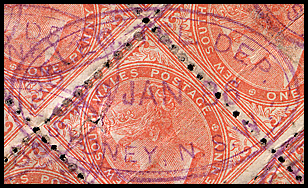 |
| Electric Telegraph Office. Name used until 1894. |
||
Two versions of the date stamp recorded and both are RO7-ETO:
|
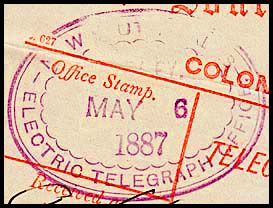 6 May 1887. Used on NC-DO-8Ab.
|
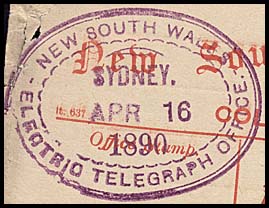 16 April 1890. Used on NC-DO-8A (with a DETAINED stamp) . |
| It is not clear if this format is a RO4-ETO or a RO7-ETO. The outer ring appears to be single but wear and use may have blurred the outer rings. The section under TELEG in the 16 April 1890 date stamp is coloured - and this date stamp has had over two more years of wear. | 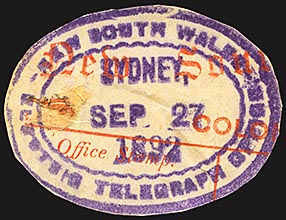 27 September 1892. Used on form NC-DO-8. |
|
Postal & Telegraph Department. This date stamp was used at both CTO Sydney and Newcastle. |
||
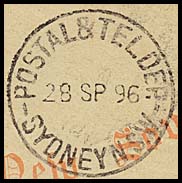
Postal & Tel(egraph) Dep, Used from 28 September 1896 to 29 May 1903. Diameter: 31 mm. The change of name was due to the merger of the two Departments in 1893.
|
Used on NC-DO-10Ba. |
|

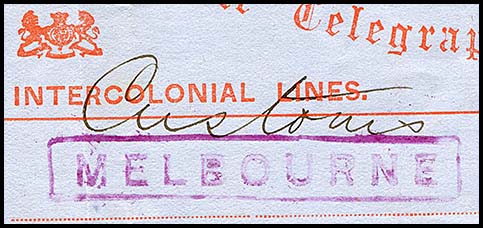
Hand stamps were used at the CTO especially during the Colonial period to save the telegraphists' time in writing commonly used sender office names. Typical examples are: |
|
MELBOURNE in purple. Size: 11 × 70 mm. Used on NC-DO-7B on 31 July 1880. |
 |
Interim/Australian period for CTO.
| Telegraph Branch. Name changed to Telegraph Branch in 1904. |
||
Telegraph Branch/ Characteristics:
|
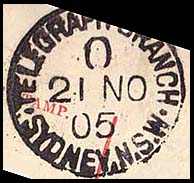 21 November 1905. Used on NC-DO-11. |
|
| Telegraph Branch/ Sydney, NSW. Characteristics:
Number in the Census: 10+.
|
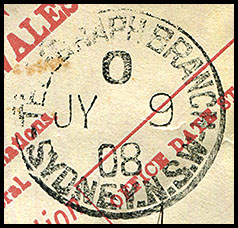 9 July 1908. Used on NI-DO-4C. |
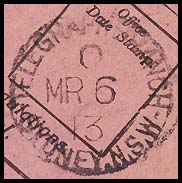 6 March 1913. Used on NI-DU-5A. |
Telegraph Branch/ Characteristics:
|
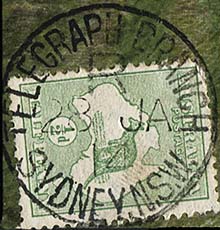 28 January 1914. Prestige Philately August 2013 Lot 424 and Abacus Auctions October 2021 Lot 486. |
|
| Telegraph Branch/ Sydney, NSW. Characteristics:
|
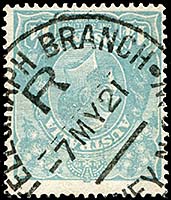 7 May 1921. |
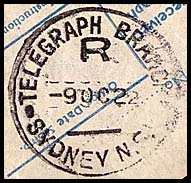 9 October 1922. Used on IAE-DC-1. |
Telegraph Branch Sydney/ NSW. Characteristics:
|
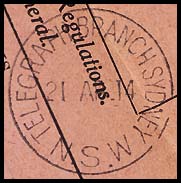 21 April 1914. Used on NI-DU-5B. |
|
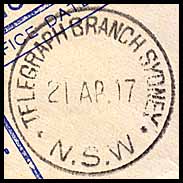
| Telegraph Branch Sydney/ NSW.
Characteristics:
|
Used on NI-DO-6D. |
|
| C.E.T.O. | ||
Characteristics:
|
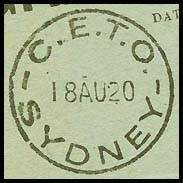 18 August 1920. Used on AE-DO-1Ea. |
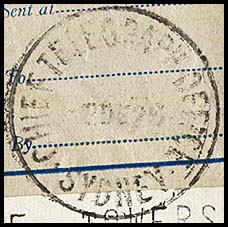
| Chief Telegraph Office (steel). | ||
Characteristics:
|
|
|
 6 January 1956. Used on AW-GCF-54B. Also used on AW-DO-10A (50). |
||
Characteristics:
See also AW-DU-9 - but a dot and a dash (18 March 1945) |
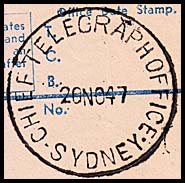 20 November 1947.
|
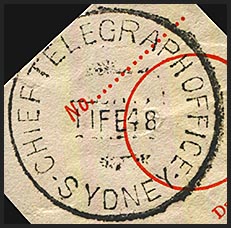 11 February 1948. |
Characteristics:
|
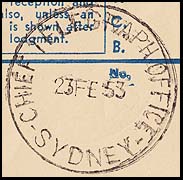 23 February 1953. Used on AW-DO-10 (47). |
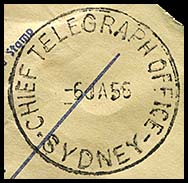 6 January 1956. Used on AW-DO-10 (54). |
 8 December 1926.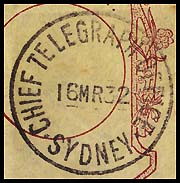
|
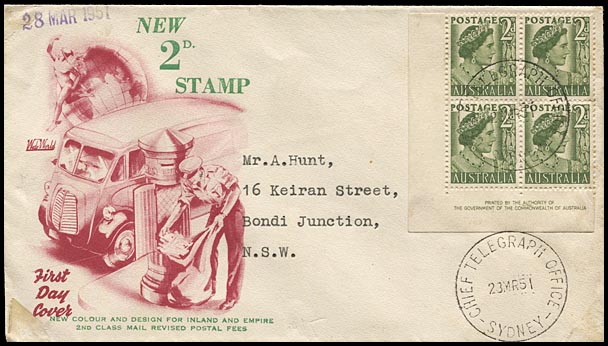
| Has N.S.W - AUST at the base with small arcs on either side.
Used in 1954 only. Rated RR. |
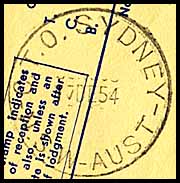 7 December 1954. Used on AW-DO-10A (1950). |
Chief Telegraph Office (rubber RC1-CTO).
Four formats were used:
All have the year in four digits. |
||
Characteristics:
|
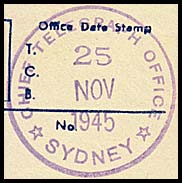 25 November 1945. Used on AW-DO-10Aa (43). |
|
|
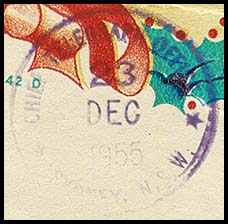 23 December 1955. Used on AB-GXF-53B. |
|
|
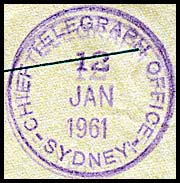 12 January 1961 Used on AW-DO-10Aa (59) |
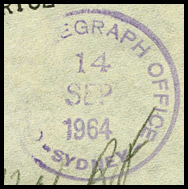 14 September 1964. Used on AA-DO-13C. |
|
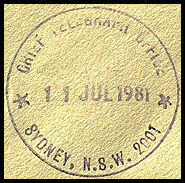 11 July 1981. Used on AT-DO-14. Provenance: Robin Hutchison |
|
| C.T.O. (rectangular).
Format 1: Year first at left followed by month and day. The usual format used post-1970 (CK) in the CTOs in each State.
|
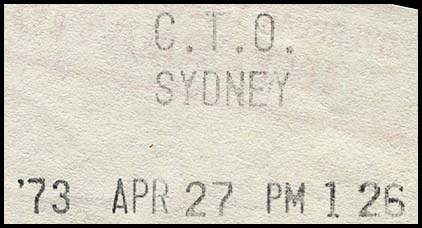 27 April 1973. Used on IAO-DO-3C.
|
|
|
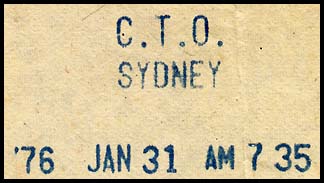 31 January 1976 at 7:35 am. Used on AT-DO-15A. |
|
| Format 2: Month and day first at left. Year last on right following time. |
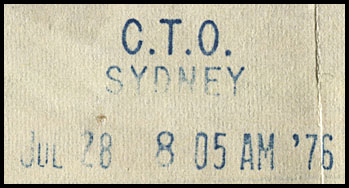 28 July 1976. Used on AA-DO-12B. |
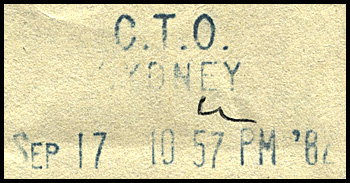 17 September 1982. Used on AT-DO-15Ca. |
| C.T.O. (circular).
A check stamp rarely seen (the word CHECK is printed vertically in the lower left quadrant with TWO vertically in the right. |
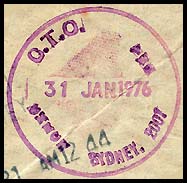 31 January 1976. Used on the same telegram as the above |
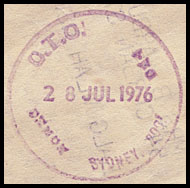 28 July 1976. Used on the same telegram as the |
| Other. | |
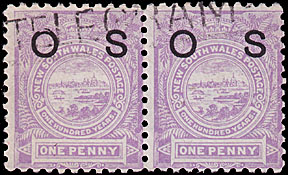 |
An unknown (and not elsewhere recorded) steel hand stamp is that of TELEGRAM in capital sans serif font 4.5 mm high.
It is assumed that it may have been prepared for the CTO Sydney. Used on a pair of 1d mauve Centennial issue View of Sydney overprinted OS. |
Electric Telegraph Stationery.
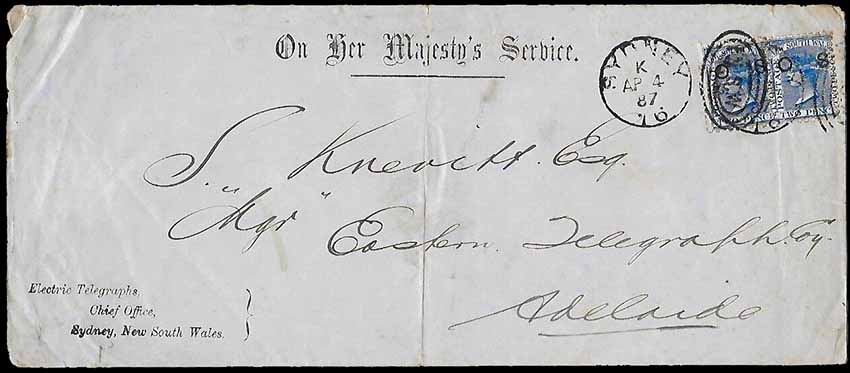
Envelopes and cards were printed expressly for the Electric Telegraph Department. Examples of these are shown below.
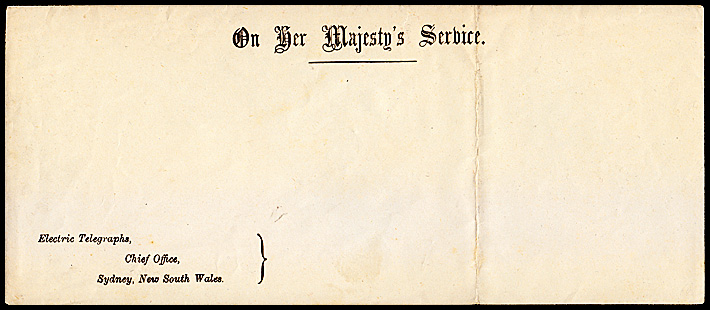 |
An unused long envelope with:
Size is 99 × 229 mm. |
 |
|
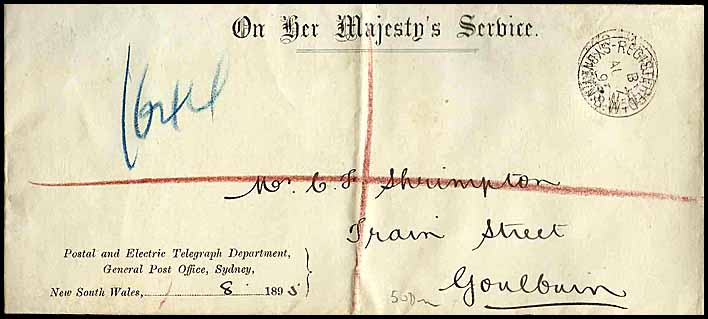 By 1895, the address details in the lower left corner had changed. |
As an aside:
STRANGE DISAPPEARANCE OF A PUBLIC OFFICIAL
On Thursday evening last (writes the Sydney Daily Telegraph of 4 July 1887)
"Mr. Charles Casperson, Assistant Manager in the Electric Telegraph Department, left his office about half-past 6 o'clock. Not arriving home at his usual hour, his friends began to be anxious and at once instituted strict inquiries with the result that up to a late hour last night, the search has only intensified the mystery surrounding his disappearance.
On the evening of the 30th, about 8 o'clock, a man answering Mr. Casperson's description hired a boat from Matson's boatshed, Woolloomooloo Bay, and said that he was going to Double Bay. If the boat was not returned that evening, he would return it early next day without fail.
The boat was not returned by him but the next morning, about 4 o'clock, the master of the harbour steamer Young Dick picked up the boat without any sculls between Bradley's Head and the light-ship. On a strict search being made in the vicinity, the Water Police found a brown over-coat, sac coat, shirt, collar, necktie and a scarf pin on the rocks between Athol Gardens and Bradley's Head which have been identified as those worn by Mr. Casperson on the day of his disappearance. The Water Police both yesterday and Saturday were dragging the harbour in the vicinity of where the clothes were found but without success The only thing which rewarded their search being the finding of one of the paddles near Athol Gardens in a position into which it had evidently been washed by the water.
So far the case is enshrouded in mystery, as there is nothing wrong in the office which would lead Mr. Casperson to commit suicide, but the police will renew the work of dragging early this morning and enquiries will be made to ascertain if there is any reason which would cause him to take the fatal step.
Mr. Casperson is an old and trusted officer in the Electric Telegraph Department where he holds the position of Assistant Manager at a salary of £450 a year".