The following information is provided below:
- details and images of the Central Telegraph Office;
- date stamps in the Colonial (pre-1901) and Interim periods:
Chief Telegraph Office/ Perth, WA - these are all oval and made from rubber;
Superintendent of Telegraphs;
Perth/W.A. - these are circular;
- date stamps in the Australian period (circular unless noted otherwise):
Steel date stamps:
Perth E.T.O.;
C.E.T.O./Perth WA;
C.E.T.O. Perth/ WA;
Chief Telegraph Office/Perth W.A.(circular);
Chief Telegraph Office/Perth(circular);
Telegraphs/Perth W.A.;
Telegraphs Perth/Western Australia;
Rubber date stamps:
Chief Telegraph Office/Perth W.A. (rectangular);
Chief Telegraph Office /G.P.O. Perth (bicoloured);
Telegraph Receiving Office/Perth. W.A.;
Telegraphs/G.P.O. Perth (oval).
- See also Slogan cancellations used at Perth.
The Central Telegraph Office in Perth.
The first telegraph office in Perth was in a room in the Town Hall on the Barrack Street frontage. There were many probems which arose from the nature and position of that Office.
For example, on 13 July 1872, the Fremantle Herald reported:
"A daring attempt to break into the Savings Bank, Perth, was made on Sunday night, during the hours of Divine Service.
About half-past seven o'clock a police constable named Bourke, who was on duty in-the neighborhood of the General Post Office, heard an unusual noise in the Telegraph Station and, listening attentively, he distinctly heard movements in the Battery Room. Jumping over the fence at the rear of the office he cautiously crept up to the window of the Battery Room and, after the lapse of a few moments, he observed a man in the act of crawling through the window.
Springing from his place of concealment, the constable arrested the would-be burglar and conveyed him to the police station close by. A powerful jemmy and other house-breaking instruments were discovered at the Battery Room, and three marks on the window showing clearly that the jemmy had been used in affecting an entrance.
The man's name is Kelly. He was taken before the Local Magistrate on Monday, and fully committed for trial. His object, no doubt, was to gain admission through the Telegraph Office into the Savings Bank which adjoins the Battery Room".
On 15 April 1874, the Inquirer reported that "The Telegraph and Post Office is being proceeded with rapidly, and will, I think, be completed before the wire is placed.
This building, no doubt, will be useful and fill a place, but as an ornament, pray don't mention it! The plan of the building is a lean to adjoining the cells at the lock-up".
But as Miranda Lambert sang "Storms never last do they baby ...". The West Australian of 30 June 1882 reported "The Government are inviting tenders for the erection of a new wing to the public offices at Perth, to occupy the site on which the Post and Telegraph offices now stand".
A new Perth P & TO was scheduled to be completed in about 1885.


As demands for services increase, so do the needs for facilities to meet those demands. The Western Mail of 22 May 1896 gave good news and bad news to its readers:
"The Post Office officials have removed to the new building. Assistance is urgently needed in both the Post and Telegraph Department".
The Inquirer of 15 January 1897 wrote a piece about the "Busy Department" in the Perth Post and Telegraph Office where overcrowding was a major concern - at least to those who worked there.
But ... on Tuesday 2 November 1897, the Daily News reported:
At about 8 o'clock last night, two youths employed on the third story of the General Post Office noticed smoke issuing from the lift which is used to convey messages from the receiving counter to the operating-room. They immediately gave the alarm to those on the premises, and also communicated with the fire brigade station.
An operator named Beilby showed considerable presence of mind by attaching one of the various hoses which are supplied by the department so as to be ready in case of emergency. He poured the water down the lift from the uppermost part of the building, while another official prevented the flames from extending to the Executive Council chambers. The water had the effect of speedily extinguishing the flames and, by the time that the brigade arrived, all danger of a serious conflagration had been averted.
The lift contains all the telegraph wires of the colony and, being constructed of gutta-percha and paraffine platting (the usual insulating material), they quickly conveyed the flames up the lift. The effect of this was that connection between the batteries and the operating-room was immediately suspended, communication with every station in the colony being cut off. As far as the chief lines were concerned, communication was restored in 45 minutes by the laying of special wires, under the supervision of Messrs. W. E. Ottaway and C. Richardson and, within the space of two hours, the whole service was in order.
The building being infested with rats, color is lent to the belief that they, having gnawed the insulating material in order to reach the paraffin, rendered it easily inflammable. The temperature again, during the past two days, favors the theory that thunderstorms might have existed in the neighborhood of some of the lines connected with Perth. In that case an extensive charge of the electric fluid would be conveyed to the head office and render ignition all the easier".
The accident exemplified the truth of the adage that misfortunes never come singly for, since Sunday, the line between Perth and Adelaide via Coolgardie, has been interrupted for the first time since its erection, rendering it necessary for all Coolgardie district business to be transmitted via Perth over the coastal line. The fire last night had the effect of further delaying messages.
It may be mentioned that "the Perth-Adelaide line is expected to be put in proper order early this moning, owing to the excellent work done by lineman Graham of Eyre, who has travelled over 85 miles of a waterless stage in two days".
The West Australian of 3 December 1898 reported:
"No further developments became known yesterday in connection with the robbery of £900 from the telegraph manager's room on Thursday.
Mr. Sholl, Postmaster-General, on being seen, said nothing further had transpired. The matter was still in the hands of the detectives and he had heard nothing from them.
During the day it was rumoured that several arrests had been made but, on inquiry last night, it was ascertained that there was no truth in the rumour".

Scanned from Souvenir of the Postal, Telegraphic and Telephone Departments
of Western Australia, GPO Perth Christmas 1898.

Scanned from Souvenir of the Postal, Telegraphic and Telephone Departments
of Western Australia, GPO Perth Christmas 1898.
Personnel:
June 1869: Mr. James Coates Fleming was the first Operator in the Perth Telegraph Office.
In April 1891, an important cricket match was held between the Post and Telegraph Department and the Public Works Department. The Post and Telegraph Department team was:
Richard A Sholl, A H Williams, E A Letch, L Ogborne, W Grundy, J P Sullivan,
W J Croft, J H Leach, F W Milbank, C Hyde, A C Baldock.
Date stamps used at the Chief Telegraph Office, Perth.
Colonial/Interim period rubber date stamps.
Chief Telegraph Office/Perth, W.A.
1. RO2 - CTO.
 16 June 1899.
Used on WC-DO-5A.
8 pointed stars separate text.
Used in violet: 16 June 1899.
Size: 28 × 43 mm (e = 0.76).
Rated: RRR.
Number in the Census: 1.
 27 January 1950.
Used in violet: 27 January 1950 and 6 February 1950.
Size: 29 × 48 mm (e = 0.80).
Rated: RRRR (not recorded elsewhere).
Number in the Census: 2.
2. RO6 - CTO with 4 pointed star.
 7 September 1891 in light blue on WC-DO-4B.
Uncoloured boxes with dot in centre in the text band. Right box is horizontal.
Used in blue: 7 September 1891 - 21 July 1893.
Dimensions: 26 × 41 mm (e = 0.77).
Rated: RR.
Number in the Census: 4.
 24 April 1904 in green on WC-DO-4B.
Used in green: 24 April 1894.
Dimensions: 26 × 41 mm (e = 0.77).
Rated: RRRR.
Number in the Census: 1.
 1 November 1894 in purple on WC-DO-4C.
 27 November 1895 in violet.
Used in purple: 1 November 1894 to 27 November 1895.
Dimensions: 26 × 41 mm (e = 0.77).br> Rated: RR.
Number in the Census: 4.
3. RO6 - CTO with multi-pointed star.
 19 September 1895 in purple.
Used on WC-DO-4Cb
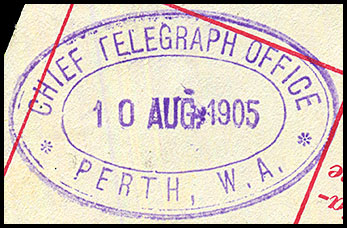 10 August 1905 in purple.
Used on WI-DO-1A.
Used in purple: 19 September 1896
and 10 August 1905.
Dimensions: 28 × 44 mm (e = 0.77).
Rated: RRR.
Number in the Census: 2.
 10 May 1906 in red.
Used on WI-DO-?
Break in both the inner and
outer frames is pronounced.
 6 June 1906.
Used on WI-DO-1B.
Break in both the inner and
outer frames is a major distortion.
Used in magenta: 10 May 1906 and 8 June 1906.
Dimensions: 29 mm × 44 mm (e = 0.75).
Rated: RRR.
Number in the Census: 2.
Major break in both the inner and
outer outer frame lines.
4. RO7 - CTO.
 22 February 1901.
Used on WC-DO-5A.
Coloured squares in text box.
Left square is horizontal.
Used in red: 22 February 1901.
Dimensions: 30 × 42 mm (e = 0.70).
Rated: RRRR.
Number in the Census: 1.
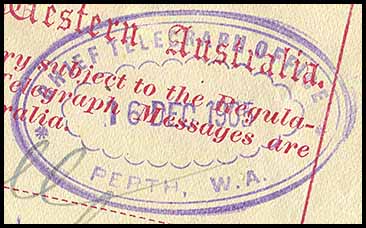 16 December 1905.
See delivery form WI-DO-1B.
 30 January 1906.
 7 February 1906.
Superintendent of Telegraphs/
Perth W.A.
RO6 - SOT
 22 August 1900.
Image by courtesy of Malcolm Brown, W.A.
Size: 27 × 43 mm )e = 0.78)
Rated: RRRRR (not recorded elsewhere).
Number in the Census: 1.

Official OHMS cover sent from the SHIP MAIL ROOM at Perth to Kograh, Sydney, NSW.
RC2 - P: PERTH at top and W.A. at base. No reference to Telegraph Office.
Unrecorded in PMI or elsewhere - perhaps too tragic to record.
Applied in various colours - see below.
Part 1: A new life.
A new circular date stamp was introduced in the second half of 1912.
 Used in red on 31 July 1912.
Used on WI-DO-5Ab.
 Used in green 2 October 1912.
Used on Collect telegram WI-DO-5Ab
with rare COLLECT hand stamp.
No reference to TELEGRAPH.
Thick letters. Double circle indistinct in parts.
The E and R of PERTH are almost touching (in friendship),
Used: 31 July 1912 and 2 October 1912.
Size: 33 mm.
Rated: RRRR.
Number in the Census: 2.
Part 2: Problems begin.
In less that a year, the top has broken (above the E and R).
 Used in violet on 9 September 1913.
 Used in violet on 10 September 1913.
Used on WI - DO - 5.
Major breaks in both the outer rings.
Used in violet. 9 and 10 September 1913.
Size: 33 mm.
Rated: RRR.
Number in the Census: 2.
Part 3: The new date stamp on the counter.
Within three months, the replacement was working well.
The new version had a large separation between the E and R.
 14 November 1913.
 25 November 1915.
Used on WI - DU- 3.
 Used in red on 4 May 1917.
Used on AE-DO-1C
Used in blue: 14 November 1913 to 4 May 1917;
Same design except for distance between E and R;
Thinner letters than previously.
Distinct double circle.
Size: 33 mm.
Rated: RRR.
Number in the Census: 3.
Western Australian steel circular date stamps.
Perth E.T.O. date stamps.
 Used in violet: 1 September 1906.
Earliest recorded date.
 Used in black on 22 April 1907.
(Electric Telegraph Office/ Western Australia).
O index above lower inscription.
Used in black : 1 September 1906 to 22 February 1912.
3 mm side arcs.
Diameter: 25 mm.
Rated: RR.
Number in the Census: 10+.
 Used: 22 May 1909.
Used on WI-DU-2.
 Used: 10 December 1910.
Used on WI-DO-3.
 Used: 22 February 1912.
Latest recorded date.
Used on the very rare WI-DO-4 with part of
a TELEGRAM stamp showing -
the remainder of the stamp being on the other side of the form.
There are three types of steel date stamp with the C.E.T.O. inscription:
1. A circular C.E.T.O. date stamp with a 28 mm diameter.
 30 January 1918.
Used on AE-DU-1A.
 6 July 1921.
On a piece with a circular steel
COLLECT handstamp in blue
(just visible in the top left corner).
Used: 30 January 1918 and 6 July 1921.
Diameter: 28 mm.
Rated: RRRR.
Number in the Census: 2.
2. A circular C.E.T.O. date stamp with a 32 mm diameter.
 24 June 1925.
Used in black: 24 June 1925.
Diameter: 32 mm.
5 mm side arcs.
Rated: RRRR.
Number in the Census: 1.
3. A circular C.E.T.O. PERTH date stamp with a 30 mm diameter.
 26 October 1929.
Used in purple.
Used in violet: 26 October 1929.
Diameter: 30 mm.
3 mm side arcs.
Rated: RRRR.
Number in the Census: 1.
Chief Telegraph Office/ Perth W.A.
There are two types of steel date stamp with this inscription:
1. A circular Chief Telegraph Office date stamp with a 29 mm diameter.
 28 September 1936.
Used on AB-GSF-36.
 23 December 1936.
Has an upright G with no horizontal bar;
No hyphen between PERTH and W.A.
No stop after A in W.A;
3 mm side arcs.
Used in black: 28 September 1936 to 23 December 1936.
Diameter: 28 mm.
Rated: RR.
Number in the Census: 5.
A variation of this date stamp (dated 7 November 1930), is shown elsewhere
on a telegram to Penfold's Wines. It appears to have had CHIEF removed.
This version of the date stamp would then be the earliest recorded.
2. A circular Chief Telegraph Office/ Perth W.A. date stamp with a 30 mm diameter.
 Used 29 May 1939.
 Used 17 November 1947.
Used on AW-DO 10B (45).
Has a horizontal bar on the G;
Has a hyphen between PERTH and W.A.
Has a stop after A in W.A;
Has dots instead of side arcs.
Used in black: 29 May 1939 to 17 November 1947.
Diameter: 30 mm.
Rated: R.
Number in the Census: 15+.
There are two types of steel date stamp with this inscription:
1. A circular Chief Telegraph Office date stamp with a 31 mm diameter.
 8 April 1953.
 5 February 1955.
Used on AW-DO-10C (52)
and on AW-GG-54A
and AW-GCF-54B.
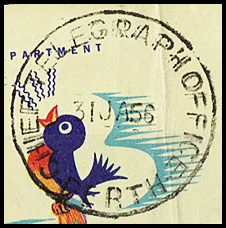 31 January 1956.
Used on a
1939 Bluebird Birthday Commemorative form
Image coutrtesy of Malcolm Brown W.A.
Only PERTH at the base.
Letters are more rounded - noticeable
especially the two Cs and the P and G.
Small dashes on either side of PERTH.
Used: 8 April 1953 to 26 December 1956.
Diameter: 31 mm.
Rated: R.
2. A circular Chief Telegraph Office date stamp with a 32 mm diameter.
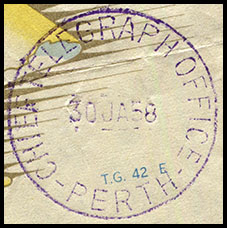 30 January 1958.
Used on an Orchid Greetings
ornamental telegram form.
 28 May 1960.
Used on AW-GS-54.
Diameter: 32 mm.
Only PERTH at the base.
Has a 1.2 mm dash between CHIEF and PERTH
and a 0.8 mm dash between Perth and Office.
Used in violet:
Used: 30 January 1958 and 28 May 1960.
Rated: RRRR.
Number in the Census: 2.
There are five formats for this TELEGRAPHS inscription on steel circular date stamps:
1. Two line date - month before day.
Has the letter "A" under the heading above the date.
Small dots for separation.
 23 August 1902.
 19 September 1902.
Used: 23 August 1902 to 28 May 1910.
Diameter: 20 mm.
Rated: RRRR.
 5 April 1905.
On 9d orange Swan.
 6 November 1906.
T and A broken.
Day and Month reversed.
Used on a Non-Delivery form.
 28 May 1910.
Used on WI-TO-2C.
2. One line date - day before month/year.
Has no separation dot between TH and W.
has no stop after (W.)A
Has 2 mm side arcs.
 3 May 1917;
10/- pink Kangaroo of Map.
 29 September 1917;
£ 1 blue and brown Kangaroo of Map.
Grosvenor Sept 2026 Lot 325.
 10 January 1935.
Used: 3 May 1917 to 10 January 1935.
Diameter: 28 mm.
Rated: RRR;
Number in Census: 8.
Telegraphs. Perth/
WESTERN AUSTRALIA.
 3 April 1930.
Used on AB-DO-6B.
 30 March 1931.
Has dot between TELEGRAPHS and PERTH
but no other separation markers.
Usage: 3 April 1930 to 8 September 1934.
Diameter: 26 mm.
Rated: RRRR.
A remake of the date stamp (SC1 - T).
- dot between TELEGRAPHS and PERTH retained;
- WESTERN AUSTRALIA replaced with W.A. at the base.
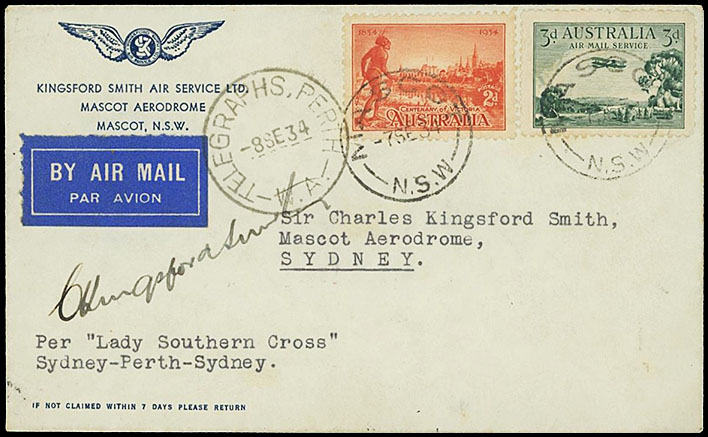
Abacus Auctions 260, June 2025, Lot 2096.
A rubber rectangular Chief Telegraph Office date stamp.
There are four types of rubber rectangular date stamp for Perth.
1. A rectangular Chief Telegraph/ Office/ ?? W.A. date stamp (RRH2 - CTO).
 12 January 1905.
Used on WI-DO-1A.
Used: 12 January 1905.
Size: 27 × 37 mm.
Rated: RRRR (not listed elsewhere).
Number in the Census: 1.
2. A rubber rectangular CHIEF TELEGRAPH OFFICE/G.P.O. PERTH. date stamp (RRH1 - CTO).
 11 February 1957.
Used on AA-DO-13A (ERD).
Used: 11 Feb 1957 to 24 March 1958.
Size: 25 × 52 mm.
Rated: RRRR (Unrecorded by P.M.I.).
Number in the Census: 3.
3. A rubber rectangular CHIEF TELEGRAPH OFFICE/G.P.O. PERTH. date stamp (RRH1 - CTO).
 31 July 1961.
Used on AA-DO-13B.
 1 February 1966.
Used on AA-DO-13D.
Used: 24 March 1958 to 1 February 1966.
Size: 26 × 47 mm.
Rated: RRRR (Unrecorded by P.M.I.).
Number in the Census: 4.
4. A rubber rectangular CHIEF TELEGRAPH OFFICE/G.P.O. PERTH. date stamp (RRH1 - CTO).
 29 May 1963.
Used: 29 May 1963.
Size: 26 × 44 mm.
Rated: RRRR (Unrecorded by P.M.I.).
Used on a delivery envelope.
Number in the Census: 1.
 12 June 1976.
Day and date reversed from usual pattern.
Date in red - other info in blue.
Used on AA-DO-13D sent by
Charles Court (Premier of Western Australia)
to Charles Pegler for his Queen's Birthday Honour).
Date stamp - blue and red.
(this and the next version are the only bi-colour date stamps recorded across
all Australia/Colonial Postal administrations).
Size: 30 × 49 mm.
Rated: RRRRR (Unrecorded elsewhere).
Number in the Census: 1.
 3 November 1982.
Used on AT-DO-15B.
Day and date in usual sequence.
Image kindly supplied by Malcolm Brown of WA.
Date stamp - blue and red.
Rectangular rubber date stamp (RRH - CTO) without frame.
Used: 3 November 1982.
Size: 33 × 51.5 mm. (approximate)
Rated: RRRRR (Unrecorded elsewhere).
Number in the Census: 1.
6. A rubber oval Telegraph Receiving Office date stamp.
A RO7 - TRO /Perth W.A. date stamp (RO7 - TRO).
 14 April 1905
(year blocked out but a 2nd date stamp on the form
for confirmation of the year).
Used on WI-DO-1A.
 3 April (no year discernable).
Unlisted elsewhere.
Used in purple: 14 April 1905 and 3 April ????.
Size: 31 × 49 mm (e = 0.77).
Rated: RRRR.
Number in the Census: 2.
Rubber oval date stamp (RO2 - T).
 1 December 1949.
Used: 1 December 1949.
Size: 34 × 43 mm (e = 0.61).
Rated: RRRR.
Number in the Census: 1.