Australia - Brown years: 1917-1922.
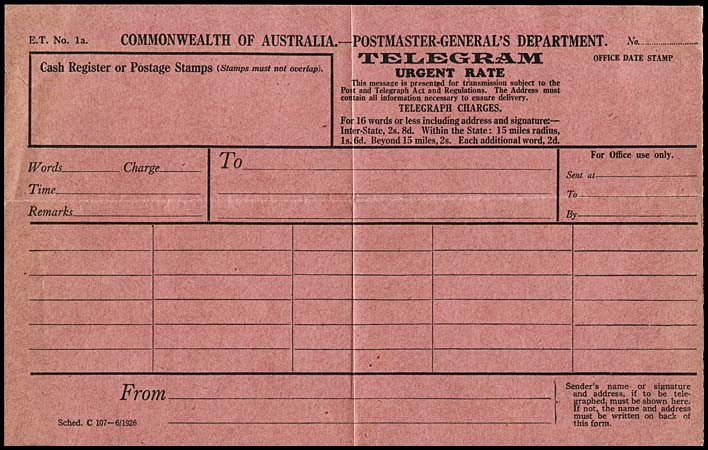
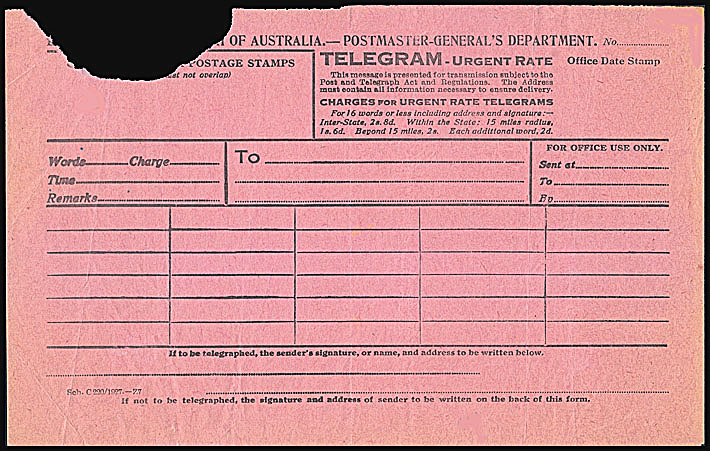
Urgent rate transmission form: AB-TU-4.
Queensland
South Australia
Tasmania
Victoria
Western Australia
International
Special aspects
Urgent rate transmission form: AB-TU-4.
- Australia 1901-1988
- New South Wales
- Overview of NSW
- Telegraph lines
- Telegraph Offices
- Date stamps
- Forms
- Envelopes
- Instructional annotation
- Collect
- Delayed
- Free
- Immediate Urgent
- Reply paid
- Rates
- Rates
- Summary of Telegram rates 1858-1900.
- NSW - Qld rates 1858 to 1870
- NSW - Vic rates 1858 to 1870
- Stamps
- 1871 Telegraph stamps
- 1885 proposal
- 1893 proposal
General characteristics:
| Heading and notes: | Form Number E.T. No. 1a. TELEGRAM - URGENT RATE in one or two lines. Four boxed sections. |
| Message area: | 30 boxes in six lines. |
| Reverse side: | Blank. |
| Colours (text & form): | Black on deep pink. |
| Size of form overall: | 127 × 201; |
Distinctive characteristics of the form:
Details of use and rarity.
| Form sub-number |
Schedule number | Earliest recorded date | Rarity rating |
| TU-4A | Sched. C. 107 - 6/1926. | None seen used. | R |
| TU-4B | Sch. C220/1927. - Z7 | None seen used. | R |