The Post & Telegraph Offices in the Wheatbelt region are listed in the table below:
The Wheatbelt region extends west from Perth to just past Southern Cross. To the north of Perth it extends to past Dandaragan. To the south it extends to just beyond Arthur River and inland from Collie.
Given the nature of the development of the telegraph line south from Perth to Albany, it is more convenient to include the relevant Telegraph Offices in the Southern region here in the Wheatbelt region.
Originally 125 mile. It is located between Williams and Kojonup.
After a petition was lodged for a Post & Telegraph office in late 1881, approval for such an Office was given on 5 July 1882 and an office had been opened (probably in a room at the north end of the public house) by 3 August 1882. But the West Australian of 14 November 1882 reported
"(the paper) had hoped to be able to chronicle the opening of our Telegraph Office ere this. It seems very hard to understand why there should be
this seemingly unnecessary delay. I have heard doubts expressed as to the paying capabilities of an office here. Personally I have not the slightest doubt that it will be found very remunerative indeed provided it has the confidence of the local public.
But I do not for a moment think that, when the memorial was signed asking Government to grant an office here, it was intended that it should be used as a draw for either a public house or a general store. To judge however, by the very close distance it is from the former, and the avowed intention of the landlord to open a general store in the room adjoining the office, one would think that such were the case. It certainly might have been placed in a more advantageous position".
In November 1882, the Gazette notified that "a new Telegraph Station has been opened at Arthur River, Albany Road for purposes of traffic. The Office hours were 11 to 12 noon; 2 to 3 p.m.; and 7 to 8 p.m.".
The West Australian of 15 May 1883 reported on the effect of these hours of opening:
"Settlers are complaining of the unusually short time during which the Post and Telegraph offices are open for the transaction of business. The hours are very inadequate and are a source of great annoyance to those intending to make use of the offices. The unusually long space of fifteen hours elapses between the final closing of the offices on one day and the opening of them on the next.
The Postmaster General has been written to and replied that, at present, he could not recommend any further extension of the hours stating that they were fixed with the double object of affording ample convenience to the few scattered settlers in the district and to limit interference with the through traffic. The latter may be taken as the reason why the hours are so short and points to the fact that, before long, a duplicate wire will have to be erected. If the present through traffic is so great that it interferes with local messages - which it has in more cases than one - I would ask what will it be when the line to the North West is completed?
A memorial is in course of preparation, signed by all the principal settlers, proving that His Excellency will be pleased to grant an extension of the hours which, it is hoped, will have a successful result and be the means of allowing this district the same privilege as are enjoyed by the Williams and Kojonup as to full office hours".
The Postmaster/Telegraphist at Arthur River had a salary of £45 p.a. in 1882.
The Post Office had been opened on 1 January 1866. For further details of the special heritage aspects and history of the Arthur River Post Office see State Heritage.
Personnel.
January 1866: Miss Mary Ann Spratt was appointed Postmistress at 125 Mile.
July 1897: "Regret is expressed at the departure of Miss Agnes Pollard from the Telegraph Office at the Arthur River, where she has been in charge for the last six years.
She has been promoted to the Quindalup station. A dance in her honor is to be given in Wagin this evening".
May 1906: "Miss Matilda Brown, the Postmistress at Arthur River received a notice of her promotion to Wandering.
Her replacement was her sister, Charlotte Brown, also of Arthur River.
No doubt Matilda Brown, the “obliging young postmistress”, relished the opportunity to take this promotion as it would save her the three mile walk to and fro’ each day".
(Heritage Council of WA).
Date stamps
A rubber oval Telegraph Office date stamp (RO6-TO) was issued to Arthur River in December 1901.
It was used in violet throughout the period to 1 May 1908.
It was 26 × 41 mm (e = 0.77) in size. Ten examples are recorded and hence it is rated RRRR.
 9 December 1901 (with year inverted).
Earliest recorded date (and in Matilda's time).
 9 September 1904.
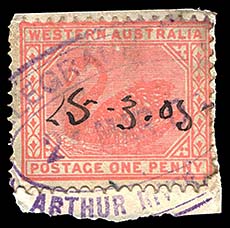 25 March 1905.
Has a manuscript cancellation.
 3 August 1906.
Very early in Charlotte's time.
 April 1907.
 19 November 1907.
Still in Charlotte's time.
 3 April 1908 (latest recorded date)
(also in Charlotte's time).
Situated between the towns now known as Armadale and Williams.
A Post Office had opened on 1 December 1869 then the Post and Telegraph Office opened on 28 February 1881.
Unfortunately it closed on 14 February 1902 - presumably because the office had no Valentine  .
Personnel.
 Mr. B. Johnson, Linesman,
Scanned from the Souvenir of the
Postal, Telegraphic and
Telephone Departments of
Western Australia,
GPO Perth Christmas 1898.
 Mr. Jas. Wear, Linesman.
Scanned from same source.
Used on WC-DO-2B.
About 1860, George Clinch changed the name of his property from Babano to Berkshire Valley. It was an incredible property containing very large accommodation and evening larger structures for sheering, horses, etc.. The Berkshire Valley is now within the local Government area called Moora.
The Berkshire Valley Telegraph Office opened on 1 March 1874. It was operated by Miss Clinch from her homestead.
The Office was upgraded to a Post & Telegraph Office on 1 January 1884.
In 1887, the article hyperlinked above noted "a small brick building in this line is used as a Telegraph Office and an operator kept here by the authorities".
The combined Office closed on 28 February 1891. It reopened in September 1894 (dates reported are 14, 19 or 20 September) but then closed again on 30 November 1898.
Resurrection was again the order of business in July 1899 followed by a chequered history of being:
- downgraded to a Receiving Office on 11 June 1915;
- promoted back to a Post Office on 1 July 1927; and
- then closed (forever) on 31 December 1928.
As there was only about 12 miles between the township of Moora and the Property called Berkshire Valley, it is possible that the business of the latter was transferred to Moora during the closed periods and from 1929.
It is not confirmed if any date stamps were issued to Berkshire Valley. Gouldner (p. 7) hypothesises that three date stamps might have been available during the 1874 to 1891 period including at least one for a Post & Telegraph Office.
In the Colonial election of January 1889, the Telegraph Office at Berkshire Valley was one of the nominated polling places in the Toodyay district.
The telegraphic connection to Beverley was established on 6 December 1877 at 7 pm.
A Post Office had already been opened at Beverley on 1 May 1858.

Scanned from Souvenir of the Postal, Telegraphic and Telephone Departments of Western Australia,
GPO Perth Christmas 1898.

Personnel:
September 1894: F. J. Inkpen to be Post and Telegraph Master. Promoted after being the first Post and Telegraph Master at Coolgardie.
1898: Mr. A. Leach was Post and Telegraph Master.

Scanned from the Souvenir of the Postal, Telegraphic and Telephone Departments
of Western Australia, GPO Perth Christmas 1898.
Date stamps
A rubber oval POST & TELEGRAPH OFFICE date stamp (RO7-P&TO) was issued to the office.
 8 October 1899.
Used in purple: 8 October 1898.
Size: 26 × 41 mm (e = 0.77).
Rated: RRRR.
Number in the Census: 1.
 24 January 1899.
One of two ovals used on an unclaimed
Office of Titles OHMS cover sent
from Perth to Beverley (with Frank Stamp).
Arrived at the Dead Letter Office on 13 February 1899.
Used in violet: 24 January and 10 February 1899
plus 19 May 1899.
Size: 26 × 41 mm (e = 0.77).
Rated: RRRR.
Number in the Census: 3.
A Post Office was opened at Brookton on 1 January 1868.
On 15 February 1907, the Pingelly Leader reported "We are still without a telegraph station or police protection, but just at the moment the great topic of interest is the after Season's Sale at Mr. Button's Cash Benefit Stores. Buyers are realising that "distant pastures are not green", as formerly and it looks progressive and good for the town to see the steady procession of contented and laden vehicles going home every after noon 'since the Earthquake of prices occurred last Saturday".
In September 1907, applications were called for the management of a semi-official Post and Telegraph Office at Brookton. Remuneration was set at £129 per annum. The successful applicant was required to provide a suitable building for the office.

A rubber oval TELEGRAPH OFFICE date stamp with postcode was issued to the Office:
 5 October 1978.
Used in violet: 5 October 1978.
Size: 31 × 49 mm (e = 0.77).
Rated: RRRR.
Number in the Census: 1.
A Post Office was established on 11 January 1891. It was then upgraded to a Post & Telegraph Office on 31 March 1897.
Personnel:
April 1897: Mr. J. Oliver was appointed as the first Post & Telegraph Master.
The Office was issued with a rubber oval POST & TELEGRAPH OFFICE date stamp (RO4-P&TO):
 13 June 1913.
Used in violet: 13 June 1914 and 16 October 1914.
Size: 25 × ?? mm.
Rated: RRRR.
Number in the Census: 2.
Date stamps.
The Office was issued with a rubber oval POST & TELEGRAPH OFFICE date stamp (RO7-P & TO):
RO7 - P & TO.
Used in violet: 21 July 1913 to 31 May 1915.
Size: ?? mm.
Rated: RRRRR.
Number in the Census: 1.
31 May 1915 - Used on a 9d violet Kangaroo on Map (1st watermark).
Cunderdin is just east of Northam.
The Post and Telegraph Office opened as a Receiving Office on 1 July 1902 and became an Official Office on 1 July 1911.
On 26 January 1910, the Eastern Recorder updated readers with:
"There is every prospect of a Post and Telegraph Office being established in the town in the immediate future. Our space will not permit of our publishing the correspondence on the subject in this issue but may say that Mr. G. W. McKie, the Hon. Secretary of the Farmers' Progress Association, Cunderdin, received a letter from the Deputy-Postmaster-General, Perth, in which that official says "The revenue now derived from Cunderdin warrants the office being raised to semi-official status but, before taking steps in this direction, it is desirable that arrangements be made for affording telegraphic facilities".
In January 1910, the Commonwealth Gazette included "Offers will be received until Feb. 15 for the provision of suitable premises and conduction at the Post and Telegraph office at Cunderdin".
Finally the Eastern Recorder of 4 May 1910 was able to announce that "Cunderdin can now boast of a very neat Post and Telegraph Office, with comfortable living quarters, in the main street opposite the railway station. The office is in charge of Mr. W. D. Keast".
The Perth Truth of 5 July 1913 included a letter to the Editor titled "Cheery Cunderdin and its Dustiny".. In part, the letter noted:
"I have arrived here on my journey Heavenwards, and am taking a little stock of things in general. The first thing my optics fell on was the state
of the main street.
There is only one street to this cockie town and, of course, it is the main and only one. All along the gutter on the east side are the tippings and sweepings of the stores, pub and green grocery, and in fact all shops and houses, and even the Post and Telegraph office, sweep all their muck dirt, broken labels, etc., into the main street".
Date stamps.
The Office was issued with a rubber oval POST & TELEGRAPH OFFICE date stamp (RO4-P & TO):
 12 February 1915.
Used in dark blue: 12 February 1915.
Size: 25 × 43 mm (e = 0.81).
Rating: RRRR.
Number in the Census: 1.
 6 August 1915.
Size: 25 × 43 mm (e = 0.81).
Rating: RRRR.
Number in the Census: 1.
and then marked UNCLAIMED before arriving at the Dead Letter Office on 19 November 1915.
In the early days - from 1 July 1853 - Dandaragan was classified as a Stopping Place for the mails and it was centered on the Police Station. Constable Goldwyer was in charge. It remained on the main northern mail route until the route was changed to the inland on 8 January 1867.
Although the Post & Telegraph Office had been completed by 30 June 1896, the Office was not opened until 15 August 1896.
The land for the Post and Telegraph Office was designated as Public Reserve No. 2,974 in the Gazette of 26 July 1895.
The Office was downgraded to an Allowance Office on 1 June 1904.
Personnel:
September 1896: Miss A. Hall was appointed by Executive Council to be Postmistress at Dandaragan and her sister Miss E. Hall was appointed as Postmistress at Moora.
It appears that Miss E. Hall was also later appointed (in December 1897) as Assistant District Registrar of Births, Deaths and Marriages at Dandaragan but she would continue to reside at Moora.
The Post Office at Dowerin opened on 1 September 1906. It became an Official Office (with Telegraph facilities) on 1 July 1912.
Date stamps
A rubber oval POST & TELEGRAPH date stamp (RO4 - P&TO) was issued to the office for use with telegraphs.
 13 August 1913.
Used in violet: 13 August 1913.
Size: 25 × 42 mm (e = 0.80).
Rated: RRRR.
Number in the Census: 1.
 24 July 1915.
 7 February 1916.
Used in blue: 24 July 1915 and 7 February 1916.
Size: 25 × 42 mm (e = 0.80).
Rated: RRRR.
Number in the Census: 3.

Gingin is in the centre of a rich agricultural district.
"On Wednesday last our quiet little town was moved into a state of gaiety by the appearance of bunting, firing of guns, and excitement emblematic of a gala day;
it was soon known, however, that the day had arrived for the betrothal of the eldest daughter of our old friend and settler Mr. John Dewar to Mr. John Elsegood, the late telegraph contractor"
(Inquirer, 21 August 1878).
As no special date stamps for use with Telegraphs were issued to the office, the usual post office date stamp was used for telegraphic purposes.
There were several formats used. An early format was framed with a 2 digit month and a 2 digit year:
 28 May 1897.
Used: 28 May 1897.
Diameter: 21.5 mm.
Rated: R.
Number in the Census: Many.
In November 1898, a reserve was gazetted for a Post and telegraph Office at Grass Valley. A Post & Telegraph Office was established at Grass Valley on 5 July 1900. Previously the office was designated as a Receiver of Mail Bags as from 1 July 1899. From 1911 it was progressively downgraded.
A rubber oval date stamp was issued to the office. PMI claims that the date stamp was only used between 5 August 1903 and 4 October 1904. Most sources claim that it was used in violet.
Date stamps
There are two recorded examples. Both are incomplete strikes. Both have very small lettering around the outside of the oval but larger lettering for the central date.
 19 August 1903 (earliest recorded date).
Used in red.
 4 October 1904 (latest known date).
Used in violet.
4 October 1904 (in violet).
Size: 24 × ??
Rated: RRRR.
Number in the Census: 1 in red and 2 in violet.
The spelling of the town's name appears to have been interchangeable in the late 1800s between having one R or two - KELLERBERIN or KELLERBERRIN.
The telegraph line and the railway were built along the Yilgarn line which extended from Northam to Southern Cross.
A Telegraph Office opened on 1 September 1894 in a provisional location. The Daily News of 19 September 1895 reported the following interchange in the Assembly:
"The proposal to expend £580 on the erection of a Post Office at Kellerberin was objected to in the Assembly yesterday, when the Estimates were under consideration.
No one seemed to know where Kellerberin was situated and, when it was elicited that it was some miles away from Northam, the information was also adduced that it contained three settlers.
The Director of Public Works urged that the House should pass the item if only to keep the Postmaster, who was Lineman and Telegraph Operator as well, from dying of ennuiA feeling of listlessness and dissatisfaction arising from a lack of occupation or excitement.. The vote was carried".
The building completed in 1895 as Kellerberin and changed to Kellerberrin possibly about 1900. The two spellings were used interchangeably for many years.

Personnel.
A position of Messenger at the Kellerberrin Telegraph Office was created and gazetted on 5 August 1926.
A note in the Perth Daily News of 6 November 1915 reported that:
"Private G. Ford, formerly an operator in the telegraph office, and who has been wounded three times, is now telegraphist at headquarters at the Dardanelles".
The Perth Daily News of 19 September 1995 carried this account of the discussion in the Assembly on the forward Estimates:
"The proposal to expend £580 on the erection of a post office at Kellerberin was objected to in the Assembly yesterday, when the Estimates were under consideration.
No one seemed to know where Kellerberin was situated, and when it was elicited that it was some miles away from Northam, the information was also adduced that it contained three settlers.
The Director of Public Works urged that the House should pass the item, if only to keep the postmaster, who was lineman and telegraph operator as well, from dying of ennui.
The vote was carried".
Date stamps
At least three (possibly four) formats of rubber oval date stamps were issued for use with telegraphs:
1. A rubber oval TELEGRAPH OFFICE date stamp (RO6 - TO) with the name KELLERBERIN (one R).
The date stamp had a 3 letter month and a 2 digit year.
 29 January 1896 (ERD).
 10 November 1896
On registered OHMS cover sent to Perth.
 10 July 2897 (LRD).
Abacus Auction April 2019, Lot 1433.
ACE March 2023, Lot 1068.
Used in violet: 29 January 1896 to 10 July 1897.
Size: 28 × 44 mm (e = 0.77).
Rated: RRR.
Number in the Census: 5.
2. A rubber oval TELEGRAPH OFFICE date stamp (RO6 - TO) with the name KELLERBERRIN (TWO R).
The date stamp had a 3 letter month and a 2 digit year.
Goulder implies this date stamp used the spelling "Kellerberrin". Such a date stamp is unlisted elsewhere.
There is one possible example on a postcard but the date stamp is very faint.

Other details are the same as for the Type 1 images.
Has a rare Great Southern Railway GSR 4 postmark on reverse side.

The A of WA is further to the right of the 6 above indicating there must be another letter in the name.
3. A rubber oval POST & TELEGRAPH OFFICE date stamp (RO4 - P & TO) with the name KELLERBERRIN (2 R).
The date stamp had a 3 letter month and a 4 digit year.
 8 October 1913.
Earliest recorded date.
Used on a registered OHMS cover from Perth
to Kwollyinn where it was unclaimed and
returned to the Dead Letter Office.
 4 March 1916.
Latest recorded date.
Used in violet:
8 October 1913, 23 and 25 June 1913,
21 August 1915 and 4 March 1916.
Size: 28 × 43 mm (e = 0.76).
Rated: RRRR.
Number in the Census: 5.
Unlisted elsewhere.
4. A fourth date stamp is alleged to have been produced for the Telegraph Office but it has never been cited.
It is claimed top have an RO6 - P & TO format and to have ben used in about 1942.
A Post and Telegraph Office opened at Merredin on 1 July 1912.
Personnel:
November 1940: Mr. and Mrs. H. (Hec.) Wightman and son Terry left Merredin last Thursday night for Onslow where Mr Wightman has been transferred by the Telegraph Department.
The couple will be missed by a large circle of friends in this town - Mr. Wightman having been a prominent footballer and his wife a keen worker of the Towns Football Club ladies committee.
Mr. M. Ryan, from Wyalkatchem replaced Mr. Wightman on the Merredin Telegraph staff.
Mooliabeenie (or Mooliabeenee).
Located east of Gingin on the original Midland Railway between Millendon Station (near Midland) and Dongara.
A Receiving Office was established on 1 May 1905 and that was changed to a Administrative Office on 1 November 1906. No record of a Telegraph Office is known but it would have been part of the railway establishment.
Date stamps
A rubber oval date stamp was issued to the office although no information is available.
Spacing indicates the first date stamp shown has a high probability of being used at Mooliabeenie.
 6 March 1911.
 8 March 1911(?)
Used in black: 6 and 8 March 1911.
Size: ??
Rated: RRRRR.
Number in the Census: 2.
A Post & Telegraph Office was opened in the afternoon of 1 September 1896 (according to the West Australian of 3 September and months after the opening of Dandaragan). A Post Office had been opened on 1 October 1894.

Personnel:
September 1896: Miss E. Hall was appointed by Executive Council to be Postmistress at Moora and her sister Miss A. Hall was appointed as Postmistress at Dandaragan.
Date stamps
A rubber oval date stamp was used at the Office but no details have been recorded previously. The image here is a new discovery (in 2020).
The oval date stamp is of the RO6 format with the upper inscription being Post & Telegraph Office and the lower inscription being MOORA, WA.
 17 November 1942.
 13 January 1945.
Notice the wear occasioned over the two years
especially to the inner arc to the left of M(oora).
Used in violet: 17 November 1942 and 13 January 1945.
Size: 33 × 56 mm (e = 0.81).
Rated: RRRRR.
No. in the Census: 2.

(With the warning!!)
A Telegraph Office was opened at Narrogin on 8 August 1893.
Tenders had been called for a new building for the Post & Telegraph Office and Quarters were called in July 1892.
On 22 September the tender from James Mackie for the building was accepted with a price of £897 16s 6d.

Built with a combination of stone and brick.
On the right - behind the tree - is a Bakery.
Many thanks to Elizabeth Trump of the Pingelly Museum & Historical Group for advice
on the Narrogin and Pingelly Post and Telegraph buildings.

It was built next to the first and so preserved the historical transformation for once!!
Not sure when the second Office was constructed.
Personnel:
January 1891: Miss. J. C. Chipper was appointed as the Postmistress at Narrogin to replace R. Deonan who had resigned.
August 1893: Mr. R. Biedermann was appointed as the first Post and Telegraph Master. He was transferred the following year to Marble Bar.
August 1894: Ms. M. A. Hustler was appointed Post and Telegraph Mistress.
By 1902, no telegraph messenger had been appointed to the Office.
Date stamps:
Two formats for oval date stamps are known for Narrogin.
1. A rubber oval TELEGRAPH OFFICE date stamp (RO4-TO) was issued to Narrogin.
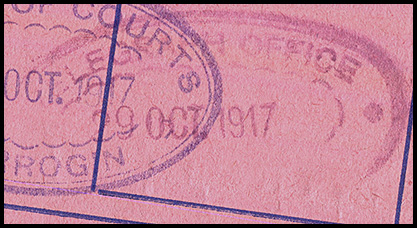 29 October 1917.
Used on WI-DU-3B.
Used on WI-DU-3C.
Used in red: 29 October 1917 and 8 January 1918.
There is a dot in the space between the lines at both ends
of the date stamp.
Size: 24 × 48 mm (e = 0.87).
Rated: RRRR.
Number in the Census: 2.
2. A rubber oval POST & TELEGRAPH OFFICE date stamp.
 14 March 1956.
Used in violet: 14 March 1956.
Size: 30 × 50 mm (e = 0.80).
Rated: RRRR.
Number in the Census: 1.
On 13 February 1927, the Perth Sunday Times carried the following story:
A MESSAGE MISSED.
UNDELIVERED UNKNOWN.
Telegraph Office in a Trance.
"On Thursday of last week The Sunday Times lodged at the G.P.O. a telegraphic message addressed to A. P. McCormick, Narrogin.
On the following Tuesday, we received a notification from the Central Telegraph Office to the effect that this most important business message
had not been delivered "the addressee being unknown".
This joke would be appreciated at Narrogin, for Mr. McCormick is so well known there that a wooden telegraph official with one eye - and that a glass one -
could have located him while the telegram was still hot off the wire. This is one of those jokes the humour of which does not appeal to the parties concerned.
Possibly Mr. Ramsay will see his way clear to declare off the hibernating season at Narrogin".
A Post Office had been opened on 14 April 1857 as Victoria Plains.
The construction of a telegraph line was approved in the early 1870s.
The office was reclassified as an Administrative Office on 21 July 1905.

Scanned from Souvenir of the Postal, Telegraphic and Telephone Departments of Western Australia,
GPO Perth Christmas 1898.
Up to the mid 1840s, New Norcia had been known as Maurin Pool. In 2022, Andrew "Twiggy" Forest and his wife Nicola purchased the old Monastry and the grounds.
The call signal around the 1880s was NL.
The position of Postmistress became available in 1873 and, with support from the Benedictine monks at that place, Mary Ellen Cuper was appointed in January 1874.
She was therefore in charge of the combined Post & Telegraph Office when it opened on 4 March 1874 - also the day when the Post Office was renamed New Norcia from Victoria Plains.
The Mount Alexander Mail of 5 October 1891 summarised the context around New Norcia:
"Miss Clarke cited the Spanish Benedictine Monastry at New Norcia, 70 miles from Perth, as the most striking refutation of the generally received belief in the irredeemable
degradation of the Australian aborigines.
Founded in 1846 by Drs Serra and Salvado (the latter of whom still governs the monastery as a mitred Abbot — the only one in Australia) this
evangelistic experiment owes its remarkable success, according to Miss Clarke, to the fact of the Spanish monks winning the confidence of the natives - by sharing their pursuits.
Thus was gradually built up the now flourishing industrial settlement of New Norcia with its monastery, church and schools surrounded by a vast cultivated domain, a variety of workshops, and a native village of 50 cottages, occupied by as many Christian families.
One black girl is actually in receipt of a Government salary as Post and Telegraph Mistress and there are other
native girls equally qualified to take her place.
The boys are said to learn with great facility and to develop into steady tradesmen and trust-worthy servants".

She was born in the Bunbury region in 1847 to a European father and a First Nations mother.
She was given the name Ellen Pangieran.
After growing up and being educated at the Benedictine Monastry, she was appointed in charge of the office
on the day it became a Post & Telegraph Office and changed its name from Victoria Plains.
Mary was the first aboriginal woman to serve in such a position.
 R.I.P.
Her prowess as shown through her interactions with the Governor of Western Australia
was reported in the Madonna Magazine in 2016.
See further information on Mary Helen Cuper.
Personnel:
January 1874: Miss Mary Cuper appointed as the first Post and Telegraph Mistress.
April 1897: Mr. C. A. Walpole was appointed Post and Telegraph Master.
January 1891: Mrs. B. Troy was appointed Postmistress and Telegraphist at New Norcia to replace Mr. (Miss??) M. A. Troy who had resigned (see Jarrahdale TO).
April 1897: Mr. C. A. Walpole was promoted to be Post and Telegraph Master.

Post & Telegraph Master 1898.
Scanned from the Souvenir of the Postal, Telegraphic and Telephone Departments
of Western Australia, GPO Perth Christmas 1898.
Toodyay was gazetted as Newcastle in 1860 when it was moved 2 km to higher ground to avoid flooding.
In 1910, to avoid confusion with the Newcastle in NSW, the name was changed back to Toodyay.
The Telegraph Office was opened at Newcastle on 6 January 1872.
The call signal around the 1880s was N.
The Toodyay Post Office had opened on 23 April 1847 but closed during the move on 6 October 1864. It was renamed from Newcastle as Toodyay P & T Office on 6 May 1910.
Personnel:
By September 1875: Mr Jas. M. Innes was Post and Telegraph Master. He married in September.
His new wife had been Miss Waters the Telegraph Master at Greenough who resigned on her marriage.
November 1891: Mr. W. Harris, the Telegraph Operator at Albany was promoted to be the Post and Telegraph Master at Newcastle.
Date stamps:

presumably used between 1847 and 1864.
Date stamps.
Three rubber oval date stamps were issued to the office for use with telegraphs when it was named Newcastle:
1. A rubber oval Telegraph Office date stamp (RO6 - TO).
This date stamp has not been seen for at least many years. It is alleged to have existed and used about 1894.
2. A RO6 - P & TO rubber oval Post & Telegraph Office date stamp.
 22 September 1898.
Earliest recorded date.
Used: between 22 September 1898 and 10 April 1902
(or possibly to 1910 when the name change occurred).
Has 2 mm side arcs below the date level.
Size: 27 × 44 mm (e = 0.79).
Rated: RRR.
Number in the Census: 6.

Used on a block of 10 1d red Swans
(reunited blocks of 4 and 6 purchased 6 years apart).
 19 April 1900.
 1 July 1901.
 10 April 1902.
Arrival backstamp on cover from England.
Abacus Auctions, February 2022 Lot 892.
3. A RO7 - P & TO rubber oval.
This date stamp has not been seen for at least many years. It is alleged to have existed and used about 1906.
4. A RO4 - P & TO rubber oval Post & Telegraph Office date stamp with the change in name from Newcastle to Toodyay.
 9 October 1918.
Used on WI-DO-5C.
Used in blue: sometime after the name change in 1910 -
9 October 1918.
Size: 25 × 44 mm (e = 0.82).
Rated: RRRR.
Number in the Census: 1.

The Post Office opened at Northam on 23 April 1847 and it was upgraded
to a Post & Telegraph Office on 11 January 1872.
The first telegraph post for the new line from Perth to York
was erected on 18 March 1871
(Perth: Inquirer and Commercial News, 29 March 1871).
The call signal around the 1880s was NR.
The office was in a very central part of the township and was used as a focus, For example, when the "Farmers Home Hotel" was to be auctioned in August 1888, the advertisements noted
"Attached to the Hotel are three full sized Town Grants, the whole enclosed, and situated in the very centre of the town,
directly opposite the Post and Telegraph offices".
Tenders were called for a new building for the Post & Telegraph Office Quarters in the West Australian of 1 September 1892 and, on 1 October,
the tender by M. Byatt and H. Cody was accepted for £975.

Personnel:
1880: Alfred Napoleon Piesse (at the age of 14) was appointed as a Messenger at Northam Post & Telegraph Office. He left in 1883 then rejoined the Telegraph Department as a Telegraphist at Esperance, Eucla, Israelite Bay, Bremer and Albany for nine years. He was a younger brother (by 11 years) of Frederick.
August 1896: Mr. J. A. W. Hillman was appointed Post and Telegraph master.
Mr. A. Russell was appointed Telegraph Officer.
January 1893: Mr. J. Oliver was appointed Assistant.
Date stamps.
Three formats for oval rubber Post & Telegraph datestamps were issued to Northam.
1. A RO2 - P & TO date stamp used in violet.
So sad that so little of the date stamp can be seen.
The most interesting aspect is that there are lines above and below the date - similar only to those in the 1896 North Fremantle date stamp.
 No discernible dates.
Used: Not clear but possibly in the late 1890s.
Size: exact measurement not possible.
Rated: RRRR.
Number in the Census: 2.
NOTE: Not recorded elsewhere.
2. a RO7 - P & TO date stamp used in violet.
 9 July 1919.
Used: 9 July 1919
NOTE: has separation dots between the upper and lower inscriptions.
A RO7 - P & TO format not recorded elsewhere.
Size: 24 × 46 mm (e = 0.85).
Rated: RRRR.
Number in the Census: 1.
(Goulder (2002) reports use of an RO2-P & TO) about 1899
but there is no confirmation of that format or early use).

Indeed there are two strikes.
3. a RO7 - P & TO date stamp.
 2 January 1940.
No separation dots.
Used in violet: about 1940.
Size: 25 × 42 mm (e = 0.80).
Rated: RRRR.
Number in the Census: 1.
Pingelly is between Beverley and Wagin. It was "replaced" to some extent by Mourambine when the railway was constructed and the postal service was transferred to the latter place.
The Post Office at Moorumbine (sometimes spelt Mourumbine) was replaced by Pingelly on 4 October 1889. It was upgraded to a Post & Telegraph Office on 1 August 1893 at a cost of £893. On 7 October 1897, the Albany Advertiser noted that "The principal buildings in Pingelly are the Post and Telegraph Office, Pingelly Hotel and the Agricultural Hall - all substantially built of brick and stone".
Elizabeth TrumpCurator of the Pingelly Museum & Historical Group., in personal correspondence, has kindly provided the following description:
"Pingelly Post Office is a single storey brick and iron building constructed in Federation Free style in 1893 to a design by Western Australian Public Works Department George Temple Poole. A new post office section, designed by W. B. Hardwick and constructed in brick with a shingle roof, subsequently replaced with iron, was added in 1918 and the original part of the building reverted to living quarters only ... Like many of Poole's Post Office designs, Pingelly P & TO had only one room for providing the Post and Telegraph services with the remainder of the building used as living quarters for the Post and Telegraph Master".
Personnel:
 Mr. W. C. Strickland,
Post & Telegraph Master from May 1894.
May 1894: Mr. W. C. Strickland was appointed as Post and Telegraph Master (see image at left).
September 1930: Mr. G. Coney, who had been stationed at Pingelly for some time
as Telegraph Mechanic, left for Bruce Rock on 12 September.
Mr. Powell of Narrogine replaced him on a permanent basis.

In Pemberton Street.
Date stamps
Three rubber oval date stamps were issued to the Office.
1. A RO2-P & TO date stamp.
 24 June 1902.
Used: 24 June 1902.
Size: 25 × 41 mm (e = 0.79).
Rated: RRRR.
Number in the Census: 2.
(the PMI illustration is less than 25% of a strike).
2. A RO7-P&TO date stamp.
 3 February 1921 (but there is evidence the telegram
may have arrived the previous day).
Used on AE-DO-1Eb.
The image has had the colour washed out to reveal
the very faint date stamp.
Form kindly supplied by Malcolm Brown, WA.
Used: 3 February 1921.
Size: 25 × 44 (?) mm (e = 0.782).
Rated: RRRRR.
Number in the Census: 1.
3. A RO6-P & TO date stamp.
 19 May 1943.
Used on a delivery form AW-DO - 9Hb.
Form kindly supplied by Malcolm Brown, WA.
Used: 19 May 1941.
Size: 31 × 50 mm (e = 0.785).
Rated: RRRRR.
Number in the Census: 1.
The area was called Southern Cross by Mr. Thomas Riseley - the first person to discover a rich series of gold reefs there. The name Southern Cross derives from the fact that Riseley had made use of that constellation as a guide while travelling by night to the spot.
The original Post Office in the area was opened at Golden Valley in 1888. After significant gold finds close to Southern Cross, the Post office was moved in January 1890.
Plans were prepared to house the Post Office and Residence, the Court House and the Mining Registrar's Office all together and a new building was approved.
Just after construction commenced, the telegraph line arrived - with no place to be housed. The Postmaster (Mr. Harvey) therefore established - in January 1892 - a site in the middle of the main street and erected a large umbrella over the instruments. The Post Office was then upgraded to a Post & Telegraph Office on 4 February 1892.
On 2 April 1892, the Western Mail noted that "the telegraph line, our first and only completed public work, is more than a success. It is a most profitable investment to the Government. Over eleven hundred messages have passed through this office this month (i.e. March)".
The Post and Telegraph became increasingly important over subsequent years as more gold was discovered in the general region and links to the areas further east increased. The Western Mail of 5 November 1910 reported:
"The volume of business at the Southern Cross Post and Telegraph Office has so increased since the inception of the present rush that a staff of 15 is now kept going where only five were formerly employed. Work in the telegraph office will be much facilitated by the installation of the duplex system, which will be in operation in a few days.
Mr. Hardman, the Deputy Postmaster-General and Mr. Woodrow, the Inspector of Post and Telegraphs, as well as Mr. Dircks, the departmental electrical engineer, are personally supervising the new arrangements of the department".
Personnel:
August 1894: Mr. J. O. Tepper was appointed Post & Telegraph Master to replace Mr Harvey.
December 1895: Mr. E. O. Sarnan was appointed Post and Telegraph Assistant.
July 1896: Mr. C. Doust was appointed Telegraph Assistant.
16 March 1897: "Fred. A. Gwynne, aged 21, telegraph operator at Southern Cross, succumbed last week to an attack of typhoid. The deceased was very popular and the funeral was largely attended".
Date stamps
The office was issued with six types of rubber oval date stamps for use with telegraphs:
1. A rubber oval POST & TELEGRAPH OFFICE date stamp (RO7-P & TO):
Size: 43 × 28 mm (e = 0.76).
Rated: RRRR.
Number in the Census: 7.
 November 1897 - earliest recorded date.
 29 March 1898.
 22 October 1898.
 23 January 1899.
Provenance: Pope.
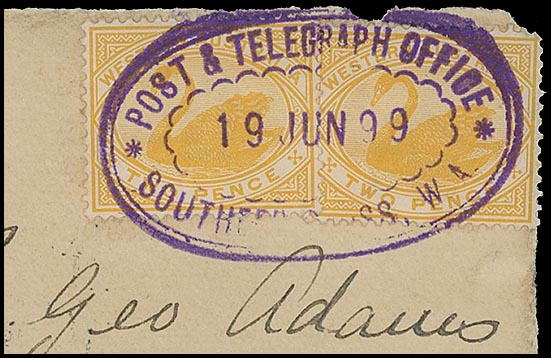 19 June 1899.
Abacus Auction 261, September 2025, Lot 1919.
 24 August 1899 .
Detail of the date stamp on the cover below.

2. A rubber oval POST & TELEGRAPH OFFICE date stamp (RO2-P & TO) -
NOT RECORDED ELSEWHERE.
 Incomplete strike showing 17 NO(?)
Only example recorded.
Rated: RRRRR.
Number in the Census: 1.
3. A rubber oval TELEGRAPH OFFICE date stamp (RO6-TO):
Rated: RRRR.
 Used in black: 25 May 1904.
Number in the Census: 1.
Rated: RRRR.
ACE Auctions, Sale 7 Lot 690.
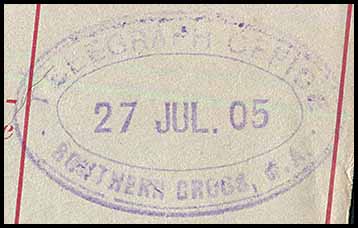 Used in violet : 27 July 1905.
Number in the Census: 1.
Rated: RRRR.
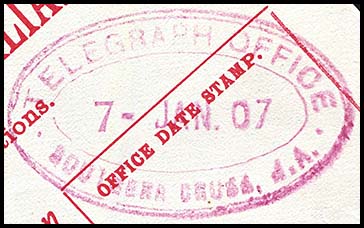 Used in magenta: 7 January 1907.
Used on WI-DO-2Ab. Number in the Census: 1
Rated: RRRR.
.
4. A rubber oval POST & TELEGRAPH OFFICE date stamp (RO7-P & TO) used in two colours.
Rated: RRRR.
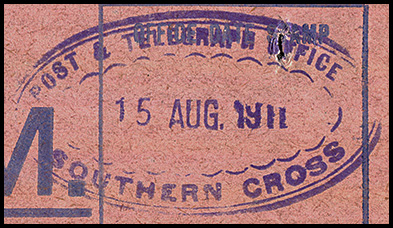 Used in purple: 15 August 1911.
Used on WI-DU-2B.
Rated: RRRR.
Number in the Census: 1.
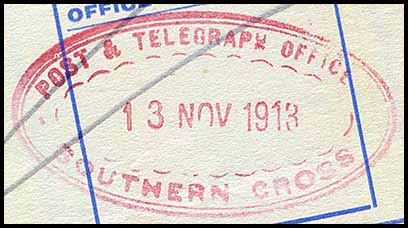 Used in red: 13 November 1913.
Used on WI-DO-5B.
Rated: RRRR.
Number in the Census: 2.
5. A RO6 - TB rubber oval date stamp was used in one colour:
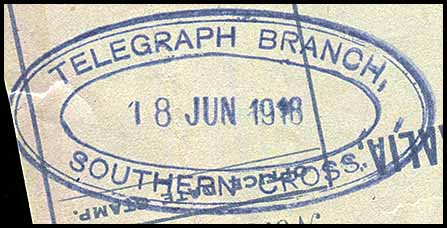 19 June 1918.
Used on WI-DO-5Ca.
Size: 25 × 53 mm (e = 0.88).
Rated: RRRRR.
Number in the Census: 1.
An unframed steel postal date stamp was also used on telegrams.
 19 December 1895.
Used on WC-DO-2B.
Unframed with two arcs around W.A.
Diameter 27 mm.
Wagin is between Narrogin and Katanning.
The Post Office at Wagin opened in January 1890 in temporary accommodation.
By May 1892, it was known that the Government intended to erect a Post and Telegraph Office at Wagin - and "to station a Constable in the township".
Plans for the combined office were drawn up by George Temple-Poole.
The Australian Advertiser of 12 September 1892 reported that "The new Post and Telegraph office is being pushed along by the contractors in a very energetic manner. It is being built of stone and will, no doubt, look well when finished."
On 18 March 1893, the Western Mail noted:
Our new Post and Telegraph Office is not yet opened, and the question is frequently asked - how much longer , have we to wait and put up with our wretched postal arrangements? Stamps are always at a premium here, and it is now fashionable to send away privately for lots of various values, other wise business would become quite blocked, so far as posting a letter is concerned. The granting of a mail westward from the Arthur River Post Office, fills a want long felt by the settlers, and places them at any rate within the radius of weekly communication with the rest of the colony".
The building was opened soon after - on 3 August 1893.
In the following week, The West Australian raised an important issue:
"With a population of 540, counting whites only, it is strange how few conveniences the Arthur possesses. No doctor nearer than thirty odd miles, no Justice of the Peace in the district, no Government school worth calling by the name, and in fact nothing that constitutes a modern community except the Post and Telegraph offices, of which we have two in the district, the one lately opened at Wagin filling a want long felt. It is to be hoped the Postmaster-General will at once make this office a money order office. Mr. Annear, the Postmaster and Telegraph Operator, is evidently the right man in the right place, and we feel he will give satisfaction to all.
The Australian Advertiser of 5 December 1892 commented that:
The stores and various out-buildings of Messrs. Piesse give the place a business aspect and, as an evidence of the growing importance of the
town, may be cited the new Post and Telegraph office which, under the supervision of Mr. James Mackie, is fast approaching completion.
This building also is of blue stone and is situated on the North side of
Tudhoe Street and about a minutes walk from the railway station. In the vacant lot between the Post Office and the big hotel may be noticed evidence of a new industry in the shape of the workshop of Mr. A Wilden".

Scanned from Souvenir of the Postal, Telegraphic and Telephone Departments of Western Australia, GPO Perth Christmas 1898.
In 1912, that building was replaced by the current building. This "new" building was designed by Hillson Beasley and built at a cost of £2,596.
The old building was converted to living quarters.

Personnel:
August 1893:
February 1894: "Mr. Osborne, of the Perth office, and who came up to put affairs in a more satisfactory state, was yesterday relieved by Mr. Twine, our new Post and Telegraph master.
July 1896: Mr. G. F. Marfleet was appointed Postmaster at Wagin.
Date stamps
Two rubber oval date stamps were issued to the office:
1. A rubber oval TELEGRAPH OFFICE date stamp.
 23 March 1900 - latest recorded date.
Used in violet: 23 March 1900
(apparently a strike is known for 17 January 1900).
Size: 26 × 39 mm (e = 0.67).
Rarity: RRRR.
Number in the Census: 1.
Very unusual to have the top inscription in
both capital and lower case letters.
2. A rubber oval TELEGRAPH OFFICE date stamp.
 22 December 1975.
An Archival strike.
Letters are now all capitals.
Used in violet: 22 December 1975.
Size: 32 × 53 mm (e = 0.80).
Rarity: RRRR.
Number in the Census: 1.
A Post Office had opened on 18 December 1866. That Office closed on 5 April 1870.
The Office was then rebuilt and reopened as a Post & Telegraph Office opened on 12 August 1896 (months after the opening of Dandaragan). The new Office was constructed with stone quarried on a nearby site. It was a repeater station to assist in the transmissions of telegraphic communications between Perth and Geraldton.
The Coolgardie Miner of 14 August 1896 announced as follows:
"We are notified by the Telegraph Department that a Telegraph Office has been opened at Walebing.
We don't know where Walebing is, but we recommend those who wish to communicate with Walebing to paste this in their hats".
Date stamp.
One rubber oval date stamp is recorded as having been used at the office:
It is a rubber oval TELEGRAPH OFFICE date stamp (RO7 - TO).
There are no references to this date stamp elsewhere.
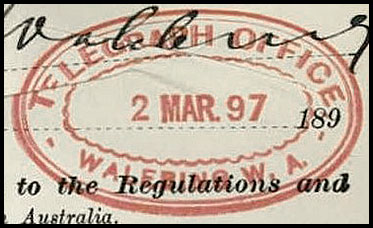 2 March 1897 - 8 months after the Office opened.
Used in red: 2 March 1897.
Size: ??
Rated: RRRRR.
Number in the Census: 1.
(not in private hands - the example known
is in the National Archives of Australia.
The Northam Advertiser of 5 May 1900 reported on a visit by the Minister of Works:
"In reference to the new railway station at West Northam, the Minister stated that, as it would be provided with a Post and Telegraph Office, there could be no question about its being utilised by the postal department. A visit was then paid to the Public School and also to the Post and Telegraph Offices and, after consultation, it was agreed to effect desirable alterations and improvements in the Post and Telegraph Offices".
It is reported that the Post Office (presumably with a Telegraph Office) was opened at West Northam on 22 January 1901.
It was apparently closed on 30 June 1901 and later reopened as an Administrative Office on 1 July 1903.
Given the following date stamp, the Office must have been operating before July 1903 and using the previous date stamp - although no evidence of a date stamp being used prior to June 1901 is known.
There is also evidence of the Post & Telegraph Office operating during the period cited above in which the office was allegedly closed.
A rubber oval POST & TELEGRAPH OFFICE date stamp (RO6 - P&TO) was issued to the office.,b> Previous descriptions only reference a sketch:
 9 May 1903.
Used: 9 May 1903.
Size: ??
Rated: RRRR.
Number in the Census: 1.
A temporary Telegraph Office was established at the Williams River during the construction of the first line from Perth to Albany.
It first established communication with Perth on 18 July 1872. By 24 August (at least), the Fremantle Herald was including in its publication a section on
INTRA-COLONIAL NEWS (Per Telegraph Williams River).
The Post Office had been opened on 13 November 1866.
By 24 January 1877, The Inquirer noted that the construction of the Telegraph Office at Williams River "does not seem to progress very fast".
As its role was essentially as a repeater station, little priority would be accorded to constructing an office.
Personnel:
1875: Mr. E. W. Snook was the Post and Telegraph Master to replace Mrs. Hegarty who was on sick leave (23 March to 27 April).
On 23 April 1875, Mrs Hegarty resigned and Mr. Frederick Henry Piesse was appointed Postmaster and Telegraphist.
He occupied that position until 1880.
During that time, he married Jane Elizabeth Chipper.
Frederick was one of the most important people in the development of the area around Katanning.
January 1893: Mr. A. W. Pierse was transferred from the Williams River to take up the new position of Postmaster and Telegraph Master at Katanning.
January 1893: Mr. G. Hustler was appointed Post and Telegraph Master to replace Mr. Pierse.
July 1896: Mr. E. J. Kennedy was appointed Postmaster at the Williams.
 Mr. E. J. Kennedy, Post & Telegraph Master 1896.
 Mr. F. A. Abbott. Linesman. 1898.
Date stamp.
Three rubber oval date stamp are recorded as having been used at the office:
- one date stamp is a 1915 Telegraph Office;
- the other two are more modern rubber ovals POST & TELEGRAPH date stamps.
 21 October 1915.
Used in red: 21 October 1915.
Size: 24 × 40 mm (e = 0.80).
Rated: RRRRR.
Number in the Census: 1.
Not listed elsewhere.
Neither of the other two Williams River date stamps have been sighted.
They are alleged to be both RO7 - P & TO types.
- one is described as having been used on July 1935.
- the other is described as being 31 × 48 mm. in size and used about 1978.
The Telegraph Office was opened on 17 January 1872. The first telegraph post for the new line had been erected on 14 March 1871 (Perth: Inquirer and Commercial News, 29 March 1871).
The call signal for York around the 1880s was Y.
Personnel:
March 1892: Mr. J. Spice was appointed Telegraph Lineman at York.
May 1894: Mr. R. J. Beswick was appointed as Post and Telegraph Master.

Date stamps.
The Office was issued with three types of rubber oval datestamps.
1. A rubber oval POST & TELEGRAPH OFFICE date stamp (RO6 - P & TO).

2 March 1903.
OHMS deleted.
Provenance: Mike Brachi.
Spink 19 May 2015, Vestey Collection Lot 453.

2. A rubber Telegraph Office date stamp (RO6-TO):
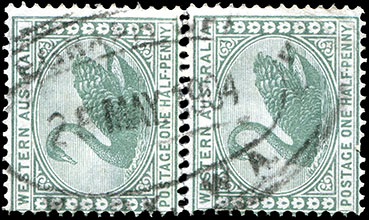 25 May 1904.
 25 July 1904.
 30 August 1904.
Used in black.
25 May, 25 July and 30 August 1904;
Size: 26 × 46 mm (e = 0.82).
Rated: RRRR.
Number in the Census: 3.
A RO7 - P & TO date stamp used about 1906 is considered by some to exist but it has not been sighted.