The Post & Telegraph Offices in the Mid-West region of Western Australia are listed in the table below:
The Mid West region of Western Australia encompasses a 472,336 square kilometres:
- the western part used to be called the Murchison. It centres on Geraldton and extends about 200 kilometres up the coast past Gregory and the Hutt River and down the coast past Dongara.
- the region extends a considerable distance inland to include the major mining areas around Cue, Mount Magnet, Meekatharra and Willuna and then down past Arrino and Carnamah.
A Post & Telegraph Office was opened at Abbotts on 17 August 1898 - the same year the town was established. It was closed on 31 October 1913.
Abbotts was the place for a number of good gold-producing mines including the Black Iguana and the Abbotts mines.
The town name was taken from the prospector Vincent Abbott who had changed his Croatian name of Vincent Vranjican.
Date stamps.
A RO6-P&TO oval date stamp was issued to the Office:
 19 April 1899.
Used in violet: 19 April 1899.
(Claimed to have been used for only 10 months).
Size: 27 × 44 mm (e = 0.79).
Rated: RRRR.
Number in the Census: 1.
A Telegraph Office was:
- opened on 1 June 1874.
- closed on 31 May 1880,
- re-opened on 18 August 1893.
- closed on 30 September 1898.
- re-opened as an Allowance Office on 1 January 1904.
The Telegraph Office was opened at Black Range in early April 1907.
No special date stamp was issued to Black Range for use with telegraphs - surprising because such a date stamp was issued to nearby Sandstone.
A Telegraph Office was opened on 5 June 1874.
"The Inquirer and Commercial News" of 10 June 1874 reported the opening as follows:
"The public may be congratulated on the fact that the telegraph is now stretched to every township in the colony south of Champion Bay - thus bringing the metropolis
into instantaneous communication with the whole of the settled districts.
At one o'clock on Friday afternoon last, at Carnamah (Mr. Duncan Macpherson's station), the Superintendent of Telegraphs — Mr. Fleming — witnessed the connecting of the last link of the northern line, and the wire was available for public purposes in less than an hour afterwards.
Thus in the space of less than five years we have spread the magic wire over about 800 miles of our territory".
 Carnamah Post Office about 1950.
The Office was upgraded to a Post & Telegraph Office in 1895.
Date stamps.
There is no record of an issue of a special date stamp for use with telegraphs at the Carnamah Office.
On the road to the north-west from Cue to Big Bell there was a town originally called Dead Finish. Gold was discovered in the area at Dead Finish in 1888.
At some stage, the town was renamed Cuddingwarra after the name of a nearby Hill (the name is derived from an Aboriginal language but its meaning has been lost).
The town of Cuddingwarra was gazetted in 1895.
An extension from the Cue - (Reedy) - Nannine telegraph line was completed in early November 1895.
Telegraphic operation had however, to wait for an Operator to be appointed.
A Post & Telegraph Office was opened on 20 November 1895.
The Office was downgraded progressively to an Allowance Office and then to a Receiving Office before being closed on 3 December 1912.
There were also three hotels.
Date stamps.
An RO4-P & TO date stamp is recorded for Cuddingwarra for use with telegraphs:
 No date.
Used in violet: ??
Size: ??
Rated: RRRR.
Number in the Census: 1.
1. Post and Telegraph Office establishment.
1. Post and Telegraph Office establishment.
Cue was the chief town in the Murchison goldfields. It was often referred to as the Queen of the Murchison.
Gold was found by Tom Cue and two mates in February 1892. The area was called Cue's Rush then Cue's Find (PO opened February 1893) and then Cue (PO 1894).
Tenders were called in July 1894 for several public buildings including a Post and Telegraph Station.
The telegraph line from Geraldton via Mullewa was connected to Cue on 12 November 1894 and a Telegraph Office also opened on that day.
Although is seems that it took nearly another 11 months to complete building the structure, there was some satisfaction in the community when the Post and Telegraph Office did finally open:
"Mr. Fels and his assistants are now fairly installed in their roomy and comfortable offices at the new Public buildings, their old tinpot structure on the other side of the street having finally been finally abandoned. The Post and Telegraph department of the Cue district is now properly housed and one standing cause for complaint is thereby removed. If only the better working of the wires could be ensured, there would be nothing left to grumble about". (Murchison Times, 9 October 1895).
In 1896, Cue was the terminus of the railway line from Geraldton but there were plans to extend that line to Nannine.
In addition to the gold, the town was surrounded by extensive pastoral interests.
 Cue about 1895.
 The Cue Post & Telegraph Office about 1895.

The earliest recorded telegram forms used at Cue are:
- a transmission form WC-TO-3B on 25 February 1899.
- a delivery form WC-DO-4Ca on 28 November 1894 - 16 days after the Telegraph Office had opened!!

Mr. E. D. Fels was appointed as the first Post and Telegraph Master at Cue.
Mr. D. F. Vincent was appointed Assistant at Cue.
In November, he was transferred to take temporary control of the new Day Dawn Office.
February 1895: E. C. Beckwith to be provisionally and temporarily, telegraph linesman at Cue.
The Murchison Times of 25 May 1895 commented on salaries:
"Postal officials and telegraph operators are wretchedly paid. The Cue postmaster, who has to work at all hours, receives £4 per week.
The Day Dawn postmaster £3 per week and operators £2 10s each.
Surely such niggardliness is most unjust".
At least 10 types of rubber oval date stamps were issued to Cue for use with telegraphs.
A detailed review of the Cue ovals is included elsewhere.
In summary, the following types are known:
 RO2 - TO - used during 1946-47.
Two formats.
 RO6 - TO - used between 1895 and 1901
(missing from Goulder (2002));

RO7 - TO - used about 1897
(missing from Goulder (2002);

RO2 - P&TO - used about 1899.
One format and with an error in C(ue).

RO6 - P & TO - used about 1900.
Two formats.

RO7 - P & TO - used between about 1905 to 1919.
Two formats.
 Cue normal postal date stamp.
13 April 1904.
Diameter: 22 mm.
Used on WI-DO-1A.
 Cue normal postal handstamp.
29 November 1934.
Diameter: 26 mm.
Used on AB-DU-3.
- Post and Telegraph Office establishment.
- The nature of the requests for an Office.
- Telegram use.
- Personnel at Day Dawn.
- Date stamps.
The Post & Telegraph Office was established on 15 November 1894. It closed on 25 October 1930.
Originally the settlement was informally called Four Mile - that being its distance from the town of Cue.
For example, in a visit to Day Dawn by Premier Forrest in April 1894, the newspapers began by noting
"On Thursday, April 26, the Premier drove down to the Four-mile from Cue and was met by a Reception Committee of the business people and the miners".
The town was gazetted as the town of Bundawadra on 2 March 1894, renamed Day Dawn on 25 May 1894 and proclaimed a municipality on 24 May 1895.
At the beginning of 1894, Day Dawn was the largest mine on the Murchison field. It had a 50 head battery of stampers and the return mostly averaged 3 to 4 ozs per ton.

Scanned from Souvenir of the Postal, Telegraphic and Telephone Departments of Western Australia,
GPO Perth Christmas 1898.
2. The nature of the requests for a Post and Telegraph Office.
The Geraldton Victorian Express of 11 May 1894 reported the following discussion with Premier Forest during his visit to Four Mile (Day Dawn):
"Mr. C. Chappie said that of their pressing wants the first was a Post Office. At present the butcher was attending to the mail.
The mail bag was dumped on the floor, and there was no security in the scramble that ensued.
A money-order office was required also, as working miners wished to send money to their wives and families in the other colonies.
A letter was read re the telegraph line stating that it would pass through the Four-Mile on its way to Cue and Nannine.
Mr Chappie hoped that this town would share in the benefits that were being bestowed on this goldfield".
Mr Tait added that the butcher had refused any longer to act as postmaster without pay and asked for some temporary building as a Post Office - also that the Four-mile mail should come direct here without going to Cue first as it was a nearer and much better road.
Mr Pell and Mr Wittenoom also spoke as to the necessity of some more satisfactory mail delivery".
During the week after the P&T Office had opened, the residents of Day Dawn held a public meeting presided over by Mr. F. Whittenoom J.P.
who was supported by his brother Mr. E. H. Whittenoom, M.L.C. who was visiting the district. The requests contained in the memorial were:
- a mail twice daily between Day Dawn and Cue;
- the issue of money orders and the registration of letters at the Day Dawn post office;
- the appointment of a telegraph messenger; and
- that a sufficient supply of postage stamps be constantly kept in stock at Day Dawn Post Office".
The Murchison Times of 25 May 1895 commented on salaries:
"Postal officials and telegraph operators wretchedly paid. The Cue postmaster, who has to work at all hours, receives £4 per week.
The Day Dawn postmaster £3 per week, and operators £2 10s each. Surely such niggardliness is most unjust".
November 1894: Mr. D. F. Vincent, who had just been appointed to the new Cue office was transferred to take temporary control of the new Day Dawn Office. In September 1895, he was confirmed in that position.
The earliest recorded telegram form used at Day Dawn is a delivery form WC-DO-4Ca for a message sent from Perth to Day Dawn on 26 November 1894.
The office was issued with at least six formats of rubber oval office date stamp:
- inscribed Telegraph Office (RO6-TO);
- inscribed Post and Telegraph Office (RO2-P & TO);
- inscribed Post and Telegraph Office (RO7-P & TO);
1. RO2 - TO.
 3 June 1896.
Year confirmed on form.
About 18 months after opening.
 2 February 1897.
Used on WC-DO-4Ca.
Used in violet: 3 June 1896 to 9 June 1897.
No stars or rosettes at the ends.
Size: 27 × 44 mm (e = 0.79).
Rated: RRRR.
Number in the Census: 5.
There are also at least 4 other strikes
in which the year digit is not printed.
2. RO2 - P & TOa.
 1 November 1898.
Has a hyphen after day and a stop after the month (in the date);
Divisions between upper and lower inscriptions are "×" level with the base of the date;
2 mm gap between (da)Y and D(awn) and between tops of N to W(A).
WA in thinner font size than Day Dawn.
Used in violet: 1 November 1898;
Size: 26.5 × 42 mm (e = 0.78).
Rated: RRRR.
Number in the Census: 2.
3. RO2 - P & TOb.
 2 December 1899.
Has a hyphen after day but no stop after the month (in the date);
Divisions between upper and lower inscriptions are thick "×" level with the middle of the date;
W.A. is in same sized font as DAY DAWN.
Used in black: 2 December 1899;
Size: 26.5 × 42 mm (e = 0.78).
Rated: RRRR.
Number in the Census: 1.
4. RO2 - P & TOc.
 1899 June 16.jpg) 16 June 1899.
Without hyphen after day (in date);
2 mm gap between (da)Y and D(awn);
WA in thinner font than Day Dawn.
Used in violet.
Size: 26 × 40 mm (e = 0.76) Note that the eccentricity of 0.76 is much less that the value for the two date stamps on either side - showing that this date stamp is tending to being rounder.
Rated: RRRR.
Number in the Census: 2.
5. RO7 - P and TO.
 17 January 1907.
AND not & after POST
W.A. not included after DAWN.
Stop after JAN.
5 mm gap between (da)N and D(awn).
Used in red: 17 January 1907.
Size: 30 × 50 mm (e = 0.80).
Rated: RRRR.
Number in the Census: 1.
6. RO7 - P & TO.
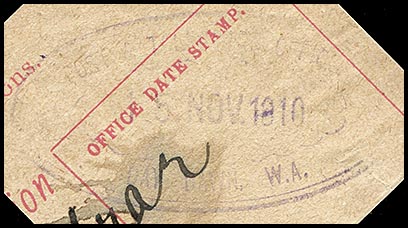 15 November 1910.
W.A. included.
Used in violet: 15 November 1910.
Size: 24 × 45 mm (e = 0.85).
Rated: RRRR.
Number in the Census: 1.
Small-scale farming by ex-convicts began in the general area in the 1860s. These operations were successful and a flour mill was constructed.
A townsite was surveyed and, in 1871, a seat of local government was established.
Churches were not built there until the 1880s.
A Post Office was opened in February 1870 when Port Irwin Post Office (which had opened on 11 October 1866) was renamed Dongarra.
Tenders were called for the erection of a new Post & Telegraph Office in August 1873.
That combined Office opened on 18 June 1874.
In 1887, Dongarra was renamed Dongara.
The Dongara Post & Telegraph Office was issued with at least two handstamps for use with telegraphs:
1. A steel Barred Letter handstamp with the letter D:
Dongara used the letter D for its telegraph call sign identification from 18 June 1874 through to 1905.
Barred Letter D.
 Used on a 1d bistre Telegraphstamp.
Very scarce combination.
Issued February 1890.
2. A rubber oval Post and Telegraph date stamp (RO7-P&T):
 The original 1887 spelling for Dongarra
has been maintained.
Size: 24 × 46 mm (e = 0.85).
Rated: RRRR.
Number in the Census: 1.
The Telegraph Office opened on 5 June 1874 as Champion Bay but soon after changed name to Geraldton.
A good review of Geraldton and its place in the gold mining of the Murchison is given in The Inquirer and Commercial News of 11 January 1895.
The prosperity of the Murchison gold fields combined with the significant exports of wool from the surrounding areas made this a very important Telegraph station.
The Telegraph call signal used around the 1880s was GT.
A relatively recent article published in the Western Mail on 23 June 1906 reported on conditions in the Office:
 Geraldton Post & Telegraph Office about 1900.
 The township of Geraldton about 1900.
The earliest recorded telegraph form used at Geraldton is a delivery form WC-DO- 3 for a message sent from Geraldton to Perth on 17 June 1881.
Telegrams were often marked with a straight-line Geraldton handstamp.

Example of the straight line handstamp on WI-DO-5A.
The Geraldton Post & Telegraph Office was issued with at least five handstamps for use with telegraphs:
- a Barred Letter with its Telegraph call signal GT. This is thought to have been used between 1887 and 1893.
The impression was not however attached to any date stamp. - two types of rubber oval date stamps;
- three types of circular date stamps.
The Geraldton Barred Letter (GT).
Geraldton used the letters GT for its telegraph call sign identification from 5 June 1874 through to 1905.
 Used on a 1d carmine Swan,
Issued February 1890.
 Used on a 2d chrome-yellow Swan
issued 1882-1885.
The rubber oval date stamps.
A rubber oval TELEGRAPH OFFICE date stamp (RO6-TO).
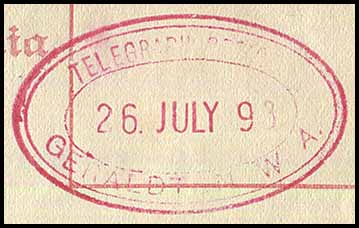 26 July 1893.
Used on WC-DO-4B.
Used: 26 July 1893, 8 February 1894 and 23 May 1894.
Size: 24 × 39 mm (e = 0.79).
Rated: RRRR.
Number in the Census: 3.
See also the 2nd form used to record
a message sent by the W.A. Reuter's Agent in Perth to Geraldton.
A rubber oval POST & TELEGRAPH OFFICE date stamp (RO6-P&TO).
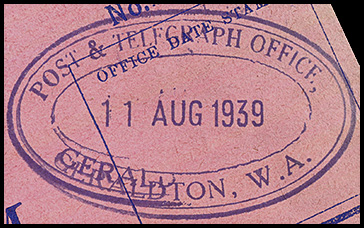 11 August 1939.
Used on WI-DU-4.
Used in violet: 11 August 1939.
Size: 29 × 49 (e = 0.81).
Rated: RRRRR.
Number in the Census: 1.
The circular steel date stamps:
A TELEGRAPH OFFICE/GERALDTON steel date stamp.
 1/- turquoise Kangaroo on Map.
Image kindly provided by
Malcolm Brown, W.A.
Used: 22 July 1920.
Diameter: ?? mm.
Rated: RRRR.
Number in the Census: 1.
A TELEGRAPHS GERALDTON/W A steel date stamp.
Dots for separation of the top and lower inscriptions.
 Telegraphs Geraldton/W.A
8 December 1922.
Diameter: 29 mm.
Rated: RRRR.
Number in the Census: 1.
In 1894, the 19 staff at the Geraldton Post and Telegraph Office comprised:
- the Post and Telegraph Master;
- 7 assistants (two appointed during the year);
- 1 booking clerk;
- 1 lineman and 1 assistant:
- 4 messengers and letter carriers;
Total 15.
To these it is proposed to add: - a senior assistant;
- 2 telephone attendants; and
- a telephone instrument fitter.
Geraldton seemed to have attracted a range of excellent people to work in the Post and Telegraph Offices there.
April 1897: Mr. H. L. Ottaway was appointed as Chief Telegraph Operator.
January 1890: Mr. J. J. Griffin was appointed Postmaster and Telegraphist at Geraldton in January 1890.
6 January 1893: The Geraldton Victoria Express reported:
"On Wednesday Miss Commerford, who, for many years past, has occupied a responsible position in the Geraldton Telegraph Office took her departure for Northampton where she has been appointed Postmistress and Telegraphist. Mr. Lloyd, who formerly performed these duties, being
required solely in connection with the railway department.
The loss of Miss Commerford's services at Geraldton will be generally regretted, but her many friends will be pleased to learn that her transfer to Northampton means real promotion. We wish her success in her new sphere".
October 1893: The Geraldton Telegraph reported:
"Mr. Sinclair, Chief Operator at the Geraldton Telegraph Office, has been promoted to be Postmaster and Telegraphist at Derby.
Mr. Sinclair, during his stay in Geraldton, has proved himself a most capable, obliging and reliable public officer, combining with efficiency in his work those equally indispensable qualifications in a Post or Telegraph officer, courtesy, civility and tact.
While congratulating Mr. Sinclair on the step he is now invited to take on the ladder of the public service, we regret on personal grounds his approaching departure from Geraldton. Between the telegraph officers and the members of the press, constant intercourse very naturally exists and our hope is that the relations between Mr. Sinclair's successor and ourselves will be as mutually pleasant as have been those now about to be severed.
Mr. Sinclair, we are sure, takes with him the good wishes of the people of Geraldton, whom he has served faithfully and well while he has been amongst them. Mr. Sinclair is son of our respected pier master, Mr. John Sinclair, of Bunbury, and first entered the post and telegraph service under Mr. Woodrow, our present postmaster".
29 September 1897: Yet another excellent person in the Geraldton Telegraph Office was promoted. The Geraldton Advertiser recounted
"His numerous friends in the district will be pleased to learn that Mr. E. H. Innes, who has for the last five years ably filled the position of Postmaster at Geraldton, is about to receive merited promotion. Mr. Innes has, we understand, been offered the responsible post of Resident Inspector of Posts and Telegraphs on the Eastern goldfields and, no doubt, will accept it. We tender him our warmest congratulations on this substantial recognition of his services while at the same time expressing regret that his acceptance of the promotion will deprive Geraldton of a most conscientious and courteous Postmaster".
February 1898: Mr. K. H. Innes, the Post and Telegraph Master, was appointed Inspector of Post and Telegraphs and based at Coolgardie.
Tenders were called for the erection of a new Post & Telegraph Office in January 1873 (and again in August 1873).
The Gazette of 3 February 1874 noted that "the tender submitted by Richard Lucas to build a Post and Telegraph Office at Greenough for £175 had been accepted".
A Post Office had opened on 1 May 1862. The Post & Telegraph Office opened on 5 June 1874.
The Telegraph call signal GR was used until 1905.
On 23 April 1884, the Inquirer reported "The measles are proving very troublesome at the Greenough, where the Post and Telegraph Mistress has been attacked by the dreaded disease:. It was certainly a major widespread outbreak with the Leader of the Telegraph Survey team then in Carnarvon being similarly affected.
Personnel:
September 1875: Miss Waters, Post Mistress, resigned to become Mrs. Jas. M. Innes - that gentleman then being Postmaster at Newcastle.
Early usage:
A transmission form was used at Green Ponds, Tasmania (date unknown - but maybe about 1880) to utilise a major development.
The South Australia connection to Western Australia at Eucla had been made in December 1877. This message was sent from Green Ponds (on the Hobart-Launceston line in Tasmania) to Greenough utilising the inter-colonial link.
This form is the earliest evidence of a message being transmitted over that inter-colonial link.

The Greenough Post & Telegraph Office was issued with at least two handstamps for use with telegraphs:
- a Barred Letter handstamp with the letters GR;
- A rubber oval Telegraph Office date stamp (RO6-TO);
1. The Greenough Barred Letter (GR).
 Used on a 1d purple Swan.
 Used on a 2d chrome-yellow Swan
issued 1882-1885.
Courtesy of Malcolm Brown.
2. Date stamps:
A rubber oval Telegraph Office date stamp (RO6-TO) is considered to have been issued to Greenough.
No example is known.
The Post & Telegraph Office opened 2 September 1897 when the line was extended from Yalgoo.
Gullewa is now the center of the Silver Lake Resources mining operations for the Deflector mine - operating without the Telegraph Office :(.
The P&T Office was downgraded to an Allowance Office on 1 September 1901.
The town was founded by Joseph Lucas Horrocks - a convict who had been transported to Western Australia in 1851.
He had been convicted of "uttering and forgery". He was pardoned in 1856.
During the 2021 Census, 69% of the dewllings were unoccupied - so a great weekender place.
Telegraph Office
A rubber oval Post & Telegraph Office date stamp (RO2-P&TO) was issued to the office:
 12 ?? 1949.
Used in violet: 12 ???? 1949.
Size: 30 × ??
Rated: RRRRR.
Number in the Census: 1.
On 14 November 1906, the Kalgoorlie Miner reported that:
"the Postmaster - General had informed Mr. H. Mahon, M.P., that his request for the establishment of an official post and telegraph office at Meekatharra has been granted.
The office will be opened as soon as the necessary premises have been provided, and without any guarantee from the State Government.
The postmaster will also perform mining duties, and the remuneration for this will be subsequently arranged on an equitable basis, according to the work done and the accommodation provided".

Source: WA Library 217 255 PD.
The name Meekatharra is taken from the local Aboriginal name meaning "place of little water".
Date stamps.
Two formats for date stamps with Post & Telegraph Office are recorded as having been issued to Meekatharra for use with telegraphs:
1. A rubber oval date stamp (RO7 - P & TO):
 7 November (no year showing).
Used on WI - DO - 3.
Used in red: 7 November (no year showing)
Maybe in the 1910s.
Size: 23 × 48 (e = 0.88).
Rated: RRRR.
Number in the Census: 1.
2. A rubber oval date stamp (RO7 - P & TO):
 20 February 1935
Used in violet: 20 February 1935
(Goulder claims an RO2 version is known about 1928).
Size: 26 × 41 (e = 0.77).
Rated: RRRR.
Number in the Census: 1.
In addition, three formats with the TELEGRAPH OFFICE inscription were issued.
1. A rubber oval date stamp RO2-TO inscribed Telegraph Office.
 13 June 1950 - only recorded example.
Used in magenta: 13 June 1950.
Size: 29 × 49 mm (e = 0.81).
Rated: RRRR.
Number in the Census: 1.
2. A rubber oval date stamp RO2-TO inscribed Telegraph Office.
 24 October 1962 - only recorded example.
Used in violet: 24 October 1962.
Size: 31 × 52 mm (e = 0.80).
Rated: RRRR.
Number in the Census: 1.
3. A rubber oval date stamp RO2-TO inscribed Telegraph Office.
 16 December 1971 - only recorded example.
Used in violet (?): 16 December 1971.
Size: 31 × 49 mm (e = 0.77).
Rated: RRRR.
Number in the Census: 1.
A Telegraph Office opened at Melville on 13 November 1895.
A Post Office had been established in April 1892.
Tenders were called for the construction of a Post and Telegraph Office on 12 December 1893 with a closing date of 16 January 1894.
The lowest tender for the construction of the Minegew Post & Telegraph Office was submitted by H. W. Linthorne for £513 14s 9d in January 1894.
The Post & Telegraph Office was opened on 1 September 1894.
"The new Post and Telegraph Office was formally opened for business on the 1st. inst (September). The building itself is the first of its kind completed her, and, both externally and internally, is a credit to the contractor, Mr. W. H. Linthorne. The want of proper postal facilities and also of telegraphic communication has been long and seriously felt, and the advent of the official appointed to the office and who arrived last week was most welcome. The first mail delivery was made on Monday, and the despatch and convenience was a contrast with past arrangements. Mr. Bowley is the name of the gentleman who has been entrusted with the work, and he appears to be well fitted for the post".
(Geraldton Murchison Telegraph 11 September 1894).
Personnel:
March 1897: Mr. C. A. G. Payne was appointed Post and Telegraph Master at Mingenew,
Date stamps.
Two rubber oval date stamps were issued to the Mingenew office:
1. A rubber oval TELEGRAPH OFFICE (RO6-TO).
 Piece containing the Mingenew TELEGRAPH OFFICE oval.
 10 August 1907.
Used in violet: 10 August 1907.
Size: 26 × 48 mm (e = 0.84).
Rated: RRRRR.
Number in the Census: 1
(only one strike has ever been recorded).
2. A rubber oval Post & Telegraph Office (RO7-P & TO.
Allegedly used in violet and is 31 × 50 mm (e = 0.78) in size.
Mount Magnet was one of the original gold mining towns in the Mid-West and the longest surviving gold mining settlement in the State.
Mining continues there through the ASX-listed Ramelius Resources (RMS).
The region around Mount Magnet was also characterised by a very high iron content - so high indeed to affect the readings on a compass.
At Mount Magnet, magnetic north is the same as true north.
A Post Office had operated since April 1893.
Telegraphic communication was opened to Mount Magnet on 15 March 1896 with the office housed in a temporary location.
On 19 May, 1897, the Gazette advertised for tenders to construct the Mount Magnet Post and Telegraph Office.
On 17 July 1896, the Inquirer reported that "The new registrar's office and warden's court were used for the first time July 15. The building is a considerable improvement on the old canvas structure. The erection of a solid Post and Telegraph office is absolutely necessary, the officers being severely handicapped in the tin building which they now occupy".

Personnel:
July 1896: Mr. Thomas Cain was appointed Telegraph Assistant.
February 1907: Mr C. F. Annear who had capably filled the position of Post and Telegraph Master at Mt Magnet during the previous four years leaves for Davyhurst on Friday next. Mr Annear was succeeded by Mr P. J. Leyden, relieving officer, who filled the position of Post and Telegraph master till the arrival of Mr G. W. Leaf who had been appointed Post and Telegraph master there.
Date stamps.
Three types of date stamps were issued for Telegraph use:
1. a rubber oval Post & Telegraph Office date stamp
(RO4 - P&TO).
 5 August 1910.
Note the break in the inner frame on the LH stamp in front og the "5".
used in violet: 5 August 1910.
Size: 26 × 42 mm (e = 0.79).
Rated: RRRR.
Number in the Census: 1.
2. A rubber oval Mt. Magnet Post & Telegraph Office date stamp
(RO6 - P&TO).
 10 February 1943.
Used: 10 February 1943 and 8 August 1943.
Size: 29 × 53 mm (e = 84).
Rated: RRRR.
Number in the Census: 2.
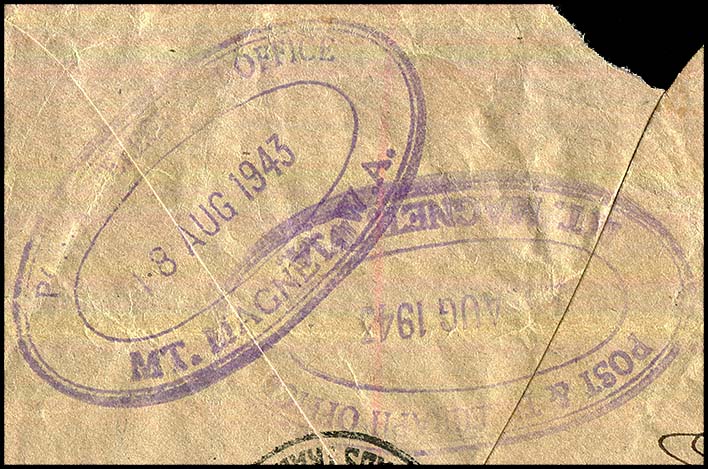
Detail of the two Mount Magnet ovals.
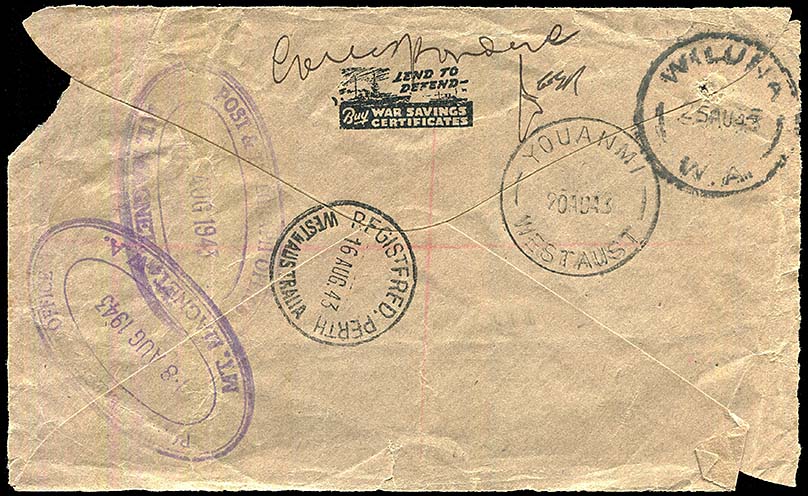
The reverse side of the wartime cover showing the transit date stamps of Wiluna and Youanmi as well as for Mount Magnet.
3. A rubber oval Mt. Magnet Post & Telegraph Office date stamp
(RO2 - P & TO).
 14 March 1945.
 6 April 1949.
Used: 14 March 1945 and 6 April 1949.
Size: 30 × 51 mm (e = 0.81).
Rated: RRRR.
Number in the Census: 2.
The usual steel date stamp used for postal purposes was also applied to telegrams.

13 August 1932.
The Post & Telegraph Office commenced operation on 12 October 1894 and opened the following day.
A Post Office had been opened in September 1892.
The Inquirer and Commercial News of 19 October 1894 reported:
On the occasion of the opening of the telegraph line to Mullewa on Saturday (12th), the following message was received by the Premier:
"We desire to congratulate you upon the prompt action taken in opening the telegraph and post offices here, which meet the demands of all portions of the community,
and we desire to thank you on behalf of the residents of Mullewa.
We believe this to be the first message from the Murchison district.
(Signed) P. Cumming and E. T. Peate.
The Premier replied: 'I thank you for your congratulatjons on the opening of the Post and Telegraph office at Mullewa.
I hope and believe that the extension of the telegraph system to all the important centres of our goldfields must assist in promoting and advancing the welfare of the colony. (Signed John Forrest.)
In a similar vein, the Geraldton Murchison Telegraph of 19 October 1894 carried the following:
"Since writing my last, Mullewa has attained a more enviable position than many more pretentious towns in this colony, as through the unceasing and indefatigable energy of Mr. Hamilton Cuming, of the Terminus Hotel, ably assisted by Mr. E. T. Peate, the general manager from Messrs. Faiz & Tagh Mahomet, the new Post and Telegraph Office has been opened since Friday, the 12th inst., and a great benefit has accrued to the general public thereby. There is now no difficulty in transacting postal business.
The gentlemen in charge, Mr. Bilby, is most courteous, and the residents here should be thankful to the department for sending along the right man for the right place.
Referring to the opening of the new Post Office, I do not think there will be anyone more heartily glad than Mrs. Judge, the late Post Mistress, who must have been simply worried to death, as her arduous duties in managing her hotel must be more than enough for any woman without the trouble of having to leave off her work to look for letters etc. in her busiest moments. Her patience and kindness as Post Mistress at Mullewa has made her popular and deservedly so".
Date stamps.
Two date stamps were issued to the office for use with telegraphs:
1. A rubber oval Post & Telegraph Office
RO6 - P&TO date stamp:
 Unknown date -
only recorded example.
Used in violet: Unknown date.
Size: ??
Rated: RRRR.
Number in the Census: 1.
It is claimed that a rubber oval RO2-P & TO Post & Telegraph Office date stamp used about 1945 also exists but it has not been cited.
Nanine was a mining town about 50 miles north-east of Cue. It was the site of the first gold discovery on the Murchison Goldfield.
When the Murchison railway was extended beyond Cue, Nannine became the ultimate terminus.
A Telegraph Office opened on 12 November 1894 to serve the population of about 300 - but also for communication for the Warden's Court to transact mining business and which sat monthly.
The Geraldton Victorian Express of 26 October 1894, took pen in hand to describe the functionality of the new office as follows:
"In my last, I noted the arrival of the new Post and Telegraph Office. It has since been erected. Like Aladdin's palace, it sprang up almost in a night.
Unlike that renowned edifice, however, it can hardly be called a "thing of beauty" or even a "joy for ever". It is only some 12 feet square, constructed of the inevitable corrugated iron.
It would do admirably during the summer season for training down light weights, and if the operator is addicted to cat-swinging, he will find his arena somewhat restricted.
He will find barely room for a comfortable sneeze".
The Day Dawn Gazette of 5 March 1896 described new buildings to be erected for the Post and Telegraph Department:
"They were to include mail and operating rooms with officers' quarters attached. Ample provision for the public convenience in sending wires or receiving letters is to be afforded by a spacious lobby fitted with all other necessaries. We may now look forward to a day when it will be possible to a write a telegram in peace, without fearing the advent of a frolicsome "cock-eye" carrying our wire to heaven before our eyes.
The buildings are to be constructed of stone with walls 13ft. in height, and surrounded with verandahs 10 ft. in width.
Our worthy postmaster will now have a habitation suitable to the dignity of his personal appearance, and our usually imposing representative of "law and order" will also be fittingly lodged".
 The new Post & Telegraph Office.
Source: Souvenir of the Postal, Telegraph & Telephone Departments
of Western Australia,
Christmas 1896.
On 10 April 1896, the Daily News reported:
"Our Nannine correspondent, wiring last night, states the contractor
for the new Post and Telegraph offices began the work of erection yesterday.
The building will be completed within three months".

Date stamps.
Until now, no special date stamp was recorded as having been issued to Nannine for use with telegraphs.
In 2015, a part date stamp was located. It is a rubber oval date stamp (RO7-P&TO) but no year is registered.
 11 May - no year.
Used in violet: May 11 ??
Day and date appear to be reversed
with a stop after the day (11).
Size: ??
Rated: RRRRR.
Number in the Census: 1.
A Post Office was opened on 20 November 1866 when it replaced Wanerenooka.
The Office was upgraded to a Post & Telegraph Office on 5 April 1878.
On 29 September 1894, the Western Mail provided the following interesting correction: "By a clerical error, a sum of £400 set down in the estimates for the York Post and Telegraph Office should have been all cated to Northampton. The York Post Office is finished".
Personnel.
January 1893: Miss Commerford was promoted to the position of Postmistress and Telegraphist at Northampton from Geraldton in (see above).
March 1911: M. S. Bell, Postmistress at Northampton "forfeited her office on marriage" - according to the Gazette.
Date stamps.
The Office was provided with three rubber oval date stamp (RO7-P&TO) of different sies which were used in black and in violet:
 10 M?? 1897.
Used in black.
Used in black: 10 May (or March) 1897.
Size: 24 × 36 mm (e = 0.75).
Rated: RRRR.
Number in Census: 1.
 18 August 1898.
Used in violet.
 6 October 1898.
Used in violet.
Used in violet: 18 August to 6 October 1898.
Size: 24 × 38 mm (e = 0.78).
Rated: RRRR.
Number in Census: 2.


The Post & Telegraph Office opened on 10 October 1898. A Post Office had been opened in December 1894.
Peak Hill is situated between the Gascoyne and Murchison Rivers about 120 miles from Nannine. Nearly all the leases for gold mining were owned by one company.
Date stamps.
Three formats for oval rubber Post & Telegraph date stamps have been recorded as having been issued to Peak Hill for use with telegraphs:
RO2 - P&TO.
 29 October 1898.
Prestige Auction, November 2013 Lot 520.
Size: 26 × 41 mm (e = 0.77).
Rated: RRRR.
Number in the Census: 4.
 December 1898 on three 3d brown Swans.
 17 December 1898.
ACE Auctions, July 2018, Lot 956.
2. RO2 - P&TO.
A date stamp with the same format is listed in one source as having gbeen used about 1912.>br> No example has been resorded to support this claim.
3. RO6 - P&TO.
 7 July 1932 (only recorded example).
Size: 26 × 48 mm (e = 0.84).
Rated: RRRR.
Number in the Census: 1.
The Post & Telegraph Office was opened at Reedy on 16 September 1935 - to overcome a most extraordinary approach to line construction using the top wire of a fence.
Reedy is located in the Murchison between Cue and Meekatharra. The town was Gazetted in 1934 after several gold discoveries during the early 1930s.

(probably mid 1930s given the telegraph/telephone posts in the town).
By courtesy of the State Library of WA.
Date stamps.
A rubber oval date stamp (RO6-P&TO) was issued to the Office for use with telegraph work. There were probably two or three rubber stamps prepared.
1. Used in red: 12 April 1940.
 12 April 1940.
Rated: RRRR.
Number (red) in the Census: 1.
NOTE: this example has a dot between the digits for the day.
The only known date stamp from Reedy struck red.
Strike on a plain cover sent to West Australian Newspapers in Perth.
There is some loss of the 2nd outer frame below (RE)EDY W(.A.).
2. Used in violet: 18 May 1940.
 18 May 1940.
Detail of the strike on the cover below.
Number (purple) in the Census: 5.

Date stamp also used in violet but ink is slightly less concentrated.
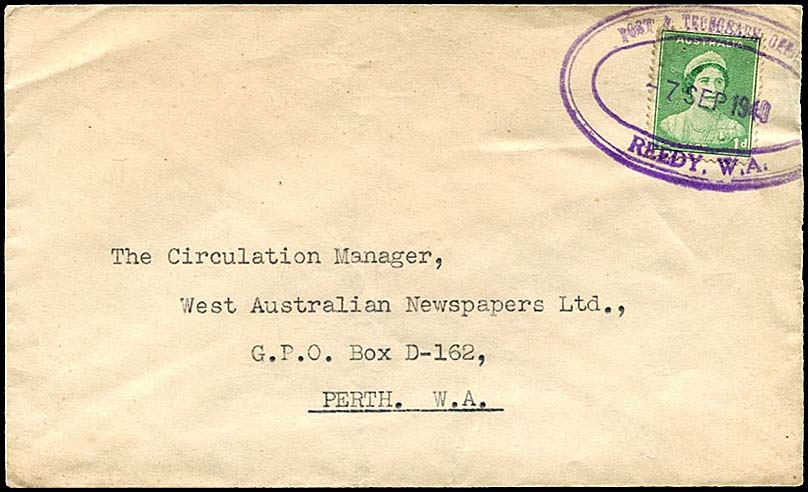
ACE Auction # 36 Lot 1637.
The Office was probably issued with two date stamps (at least) which were used during the 1940s. One date stamp deteriorated badly - the other not so much.
 16 May 1940.
The inner oval shows distortion
especially to the lower inner frame.
 The distortion is not so bad but
there are similatities in shape and position.
 The distortionn is more pronounced
and in the same positions.
These distortions are considered to be due to wear and not a change to the design.
Hence this date stamp in is various manifestations is not classified as RO7.
Sandstone was established as a town in 1894 as a result of the gold rush affecting nearby Mt. Magnet and Cue. It was closely allied to Black Rock.
A survey for the line had been completed to Sandstone in early 1907 and soon after a report indicated that the site for the Telegraph Office was to be lot 32, at the corner of Oroya and Hack streets, and immediately opposite Messrs. Clarke and Co.'s store. The approval for the purchase of the site was given in late May 1907.
A Receiving Office was opened on 15 March 1907 and upgraded to a Post and Telegraph Office on 20 May 1907.
The railway from Mt. Magnet was completed in 1910.
Personnel:
May 1907: Mr. Duggan, who was assisting Mr. Egan, Postmaster at Nunngarra, took charge of the new office and another officer arrived from Perth and joined Mr. Egan.
Early telegraph usage at Sandstone.
The earliest use of the Sandstone telegraph facility seen so far is a telegram (WI-DO-2A) sent from Sandstone to Bunbury on 10 March 1908 - about 10 months after the upgrade.
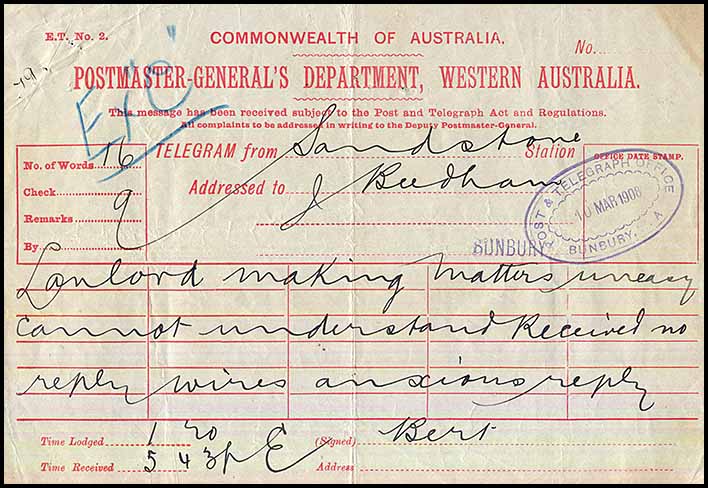
Date stamp:
The Office was issued with a rubber oval POST & TELEGRAPH OFFICE date stamp (RO7-P & TO):
 11 July 1914.
Used on reverse side of an
OHMS envelope Returned to Sender.
ACE Auctions, July 2018, Lot 846.
Used in mauve: 11 July 1914.
Also reported in 1919.
Size: 25 × 48 mm (e = 0.85).
Rated: RRRR.
Number in the Census: 1 (later date unsighted).
A Telegraph Office opened on 24 December 1897. It was upgraded to a Post & Telegraph Office in 1904.
It is reported that the Office was issued with a rubber oval POST & TELEGRAPH OFFICE date stamp (RO?-P & TO).
It has never been recorded - so its existence muct be questioned.
Gold was discovered in the area about 70 miles (120 kms) to the north-east of Mullewa from the early 1890s but especially from about 1894.
Prior to that time, the area had been principally used for grazing sheep.
The gold prospects improved over the next few years and a Post and Telegraph Office was opened at Yalgoo on 5 April 1895.
By that time, there were about 120 men working the diggings and buildings were being erected. The goldfield warden therefore asked for a townsite to be surveyed and gazetted.
Following the survey, a townsite called Yalgu was gazetted in January 1896. By 1898, the population comprised 500 men and 150 women.
No Oval date stamp was issued to the Office.


Yarrabubba is a pastoral lease sometimes referred to as Yarrabubba Station. Originally it operated as a sheep station but changed to cattle and it is still operating.
It is located about 70 km SSE of Meekatharra.
Official documents record that a Telegraph Office opened at the station on 12 September 1918.
That office officially closed on 30 June 1921 although it continued to operate until some time in 1921.
Much more well known is the Yarrabubba Impact Structure. Until 2020, it was the largest known impact structure on Earth.
Its diameter is estimated to be between 30 and 70 km and its impact on Earth is estimated to have been about 2,229 million years ago.
For further details see Wikipedia.
Date stamp.
The WASG does not have any entry for Yarrabubba while Gouldner records a single postal date stamp.
PMI records a date stamp being used (presumably for a Post & Telegraph Office) in 1921-1922.
Abacus Auctions (June 2025) claims a Post & Telegraph Office date of 30 April 1919 has been reported but without evidence to support that claim.
The image below is dated 25 May 1919.
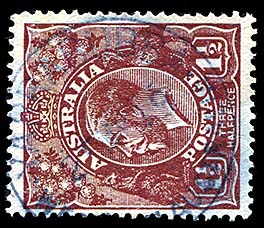
Used in blue: 25 May 1919.
Diameter: 24 mm
Rated: RRRRR.
Number in the Census: 1 (or 2).
The WA Study Group (1979) note that Yuin was a receiving Office from 22 November 1906 until it changed name to Wurarga on 1 October 1909.
A Receiving Office was reopened at Yuin on 1 July 1910.
Malcolm Brown notes Yuin was renamed Yuin Reef in 1925 and that office closed in 1925.
 Image courtesy of
Malcolm Brown, W.A.
Used in violet: 12 June 1956.
Diameter: 28 mm
Rated: RRRR.
Number in the Census: 1.